SRINAGAR: On a cold morning, a group of men on their small boats are looking for something on mid waters in world famed Dal Lake here. Are they up so early to catch rainbows? Surely not! They have no nets or angling rods. Are they there to collect fodder? No! So, guess it right – Dal does not grow green leaves on surface in winters. Well, actually the two Pheran clad men are up too early to pluck the most sought after aquatic vegetable’ –the organic Lotus Stem or Nadru as called in local parlance.
Growing naturally in major lakes in Kashmir, Nadru continues to tease taste buds and powers livelihood in the valley.
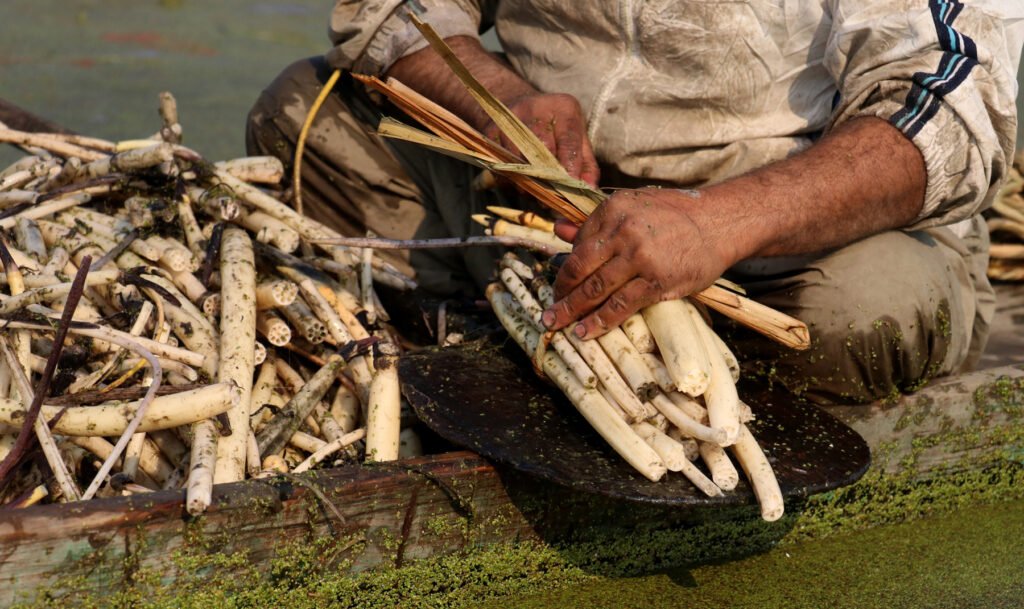
Equipped with a long stick, two Dal inhabitants 48-year-old Bahir Ahmad Akhoon and a 46-year-old Mushtaq Ahmad Akhoon are continuously dowsing the waters to locate lotus stem. As soon as they feel the obstacle with long stick, they immediately pull it out with the help of a Shum, a metal fork tied at the end of the rod. And on the surface pops up the long, cylindrical creamy white lotus stems, one of the prized vegetables of Kashmir.
Though the organically cultivated Nadru grows naturally in all the major water bodies of valley, Dal Nadur or a lotus stem from Dal lake is regarded as the best quality for its exquisite taste and whitish color.
Nadrus grow mainly between the autumn and summers. By end of March, Nadru farmers pluck out edible lotus stems worth crores.
Used widely by the valleities, Nadru has a lion’s share in Kashmir’s cuisine. Be it Eid and Navroz for Muslims or Shivratri for Kashmiri Pandit families, the waterborne vegetable is essential part of local culture.
Near and dear ones are invited and served cuisine made from Nadru. It is hardly possible that a Nadru dish is not served to invitees during the feasts organized in Kashmir families during winters.
“My son who studies abroad is returning home after a gap of one year. I am going to prepare Nadru dish for him, as he likes them the most. I am exploring what else to get with them,” says Hafeeza Akhtar from Srinagar’s Lal Bazar, while carrying a bunch of large sized Nadru in a bag.
Lotus stem is often prepared with fish that makes them ‘Nader Gaade’, a dish loved by one and all. ‘Nader Haakh’, lotus stem and Collard Green and ‘Nader Muje’, Lotus stem and radish are among the traditional dishes made from locally produced Nadru. Besides there are variety of foods ranging from street chaats to snacks and dishes whose essential ingredient is famed Nadru. In some neighbourhoods of Dal and Anchaar lake, where the lotus grows in abundance, people can be often seen drying the stuff on attics to keep it for summer use.
Such is the craze for this edible stem of symbolic lotus plant that it serves as a token of love or prized gift in Kashmir culture. A bunch of Nadru stems is a prized gift or treat exchanged between the acquaintances, friends or relatives especially during winters and festivities.
While adding colour to valley cuisine these lotus stems are a source of livelihood too. From cultivation to marketing, hundreds of families across Kashmir benefit from it. A cultivator, vegetable sellers or nadru dealer, everyone gets their share from its trade.
“I have been cultivating nadru for past 20 years. Whole men folk, my two sons and I usually harvest 10,000 to 12,000 bunches of lotus stem every year. This aquatic commodity is our major source of income,” Ghulam Mohammad Akhoon told the Valley Observer while plucking the lotus stems in Dal. “At times, I often hire people to pluck the stuff as the demand upticks during severe cold. During this period, most of people prefer to stay indoors and like to cherish Nadru dishes,”
Before being sold in market, these lotus stems are arranged in bunches, which are graded according to the length and girth of stems in a bunch. An average Nadru bunch weighing about 2 kilograms fetches between Rs 200 to Rs 300. There are some bunches which are priced up to Rs 900 in the market. The price of edible stems shoots up during festivities however.

The cultural legacy of Nadru continues despite the waterborne crop faced a near total wipe-out from Dal and Anchaar waters during the devastating floods in September 2014. In the wake of floods, many Nadru cultivators had rented marshy lands in the neighboring district of Ganderbal, preserved seed there and then again propagated it in these lakes. Thanks to these resilient Nadru cultivators, lotus in a full bloom is again a popular sight on Dal and adjacent waterbodies in the valley. The prized vegetable has re emerged as a main aquatic crop of the valley and continues to fuel the livelihoods of hundreds of families associated with the trade.
Meanwhile Akhoon who is dowsing the Dal waters, finds his catch, a long lotus stem -the Nadru!
About The Author