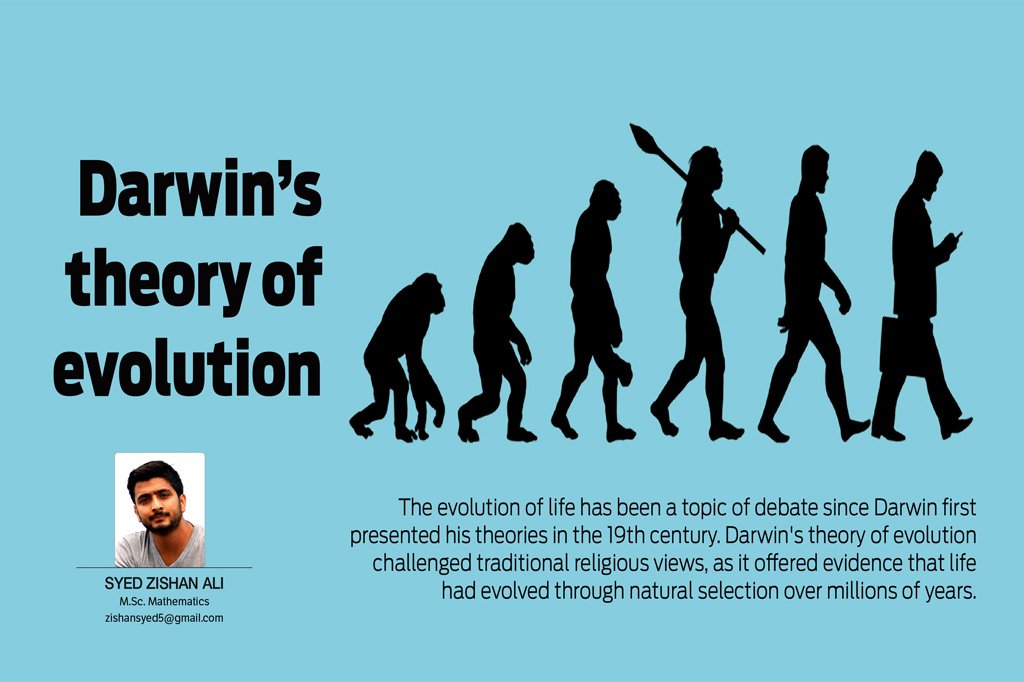
The evolution of life has been a topic of debate since Darwin first presented his theories in the 19th century. Darwin’s theory of evolution challenged traditional religious views, as it offered evidence that life had evolved through natural selection over millions of years.
This sparked heated debates between scientists and religious leaders, who argued that Darwin was contradicting the Creation story taught in many religious texts. Despite this resistance to Darwin’s ideas, scientific advancements have allowed us to uncover more evidence supporting Darwin’s theory.
Through genetic sequencing and fossil records, we can now better understand how different species evolved over time. This has helped to make Darwin’s theories more accepted by the public.
In today’s world, there is much more acceptance of evolutionary science while still allowing for religious beliefs. Darwin’s theories are now widely accepted and scientifically supported, although it took decades to overcome early resistance from the scientific community and religious groups.
Darwin’s work has been crucial in helping us better understand the evolution of life on Earth, and his ideas have greatly influenced how we view science today. Most notably, Darwin’s contributions help us to better appreciate the natural world by understanding how life forms have changed over time.
His work continues to be celebrated as a major breakthrough in our understanding of evolution, making him one of the most influential scientists in history.
Today, Darwin’s work serves as a foundation for all biological sciences and has helped us to better understand the complexities of life. It is important to remember that Darwin was one of the first biologists who proposed a explanation for life on Earth and contributed much to our current understanding of evolution and its implications for humanity.
Darwin’s findings have also had far-reaching effects in terms of how science is perceived today.
At its core, Darwin’s theory of evolution is founded on the idea that all forms of life have evolved through natural selection over time. Darwin proposed that species changed over generations due to adaptations which were favored by their environment, individual organisms with better adapted traits were more likely to survive and reproduce, passing these traits down to their offspring. By looking at fossils and living organisms today it is easy to see how Darwin’s ideas are supported by evidence.
Darwin’s theories continue to shape our understanding of biology, ecology and even anthropology today.
Since the time of Charles Darwin, more and more information has been discovered about the theory of evolution. This new knowledge has led to an in-depth understanding of how species evolve over time. With this, our view of evolutionary processes has become increasingly complex. The modern synthesis brought together genetics, biochemistry, population genetics, paleontology, embryology, and systematics to create an overarching evolutionary theory. This synthesis addressed many of the problems that Darwin was unable to explain at the time, such as the origins of new characters or traits in species.
The views expressed in the article are of the author and do not, in anyway, reflect the opinion of the Valley Observer