


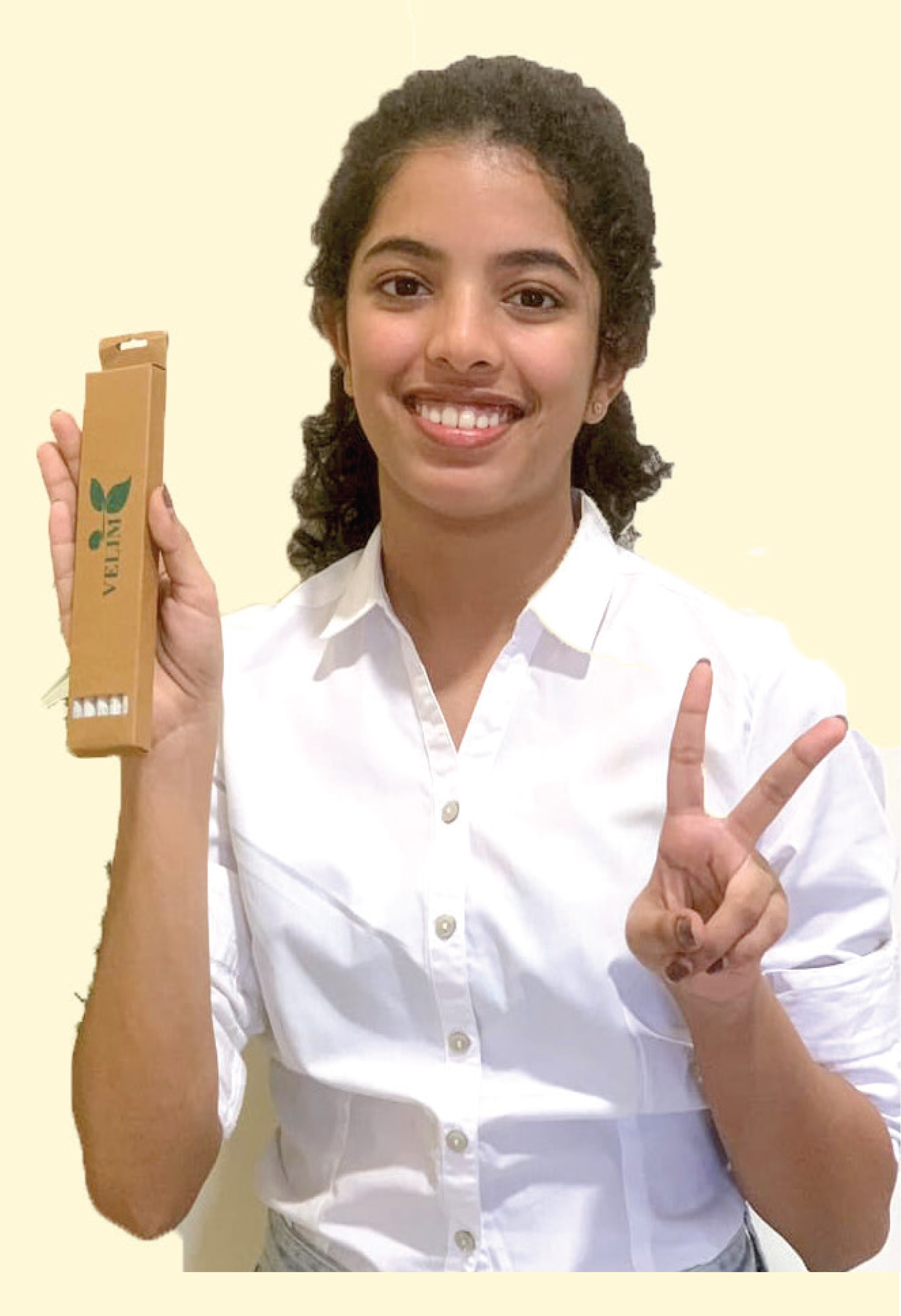
Her pledge to reduce the usage of plastic pens by substituting them with eco-friendly alternative has become a reality as Kaydence Rodrigues, an 18-year-old has scripted her success story with her first lot of pencils made out of recycled newspapers hitting the markets. The Valley Observer in conversation Kaydence Rodrigues, the young Co-Founder of ‘Velim Eco’ manufactured and promoted by Goa-based startup Syamantaka Technologies Private Limited. She spared time for the interview, just ahead of the launch of her dream venture, which hit the markets on February 14
Valley Observer: What inspired you to the mission “Say No to Plastic Pens, Say Yes to EcoFriendly Pencils’?
Kaydence: Well, as you know countries around the world including our homeland India have pledged to drastically cut down on their dependency on single-use plastics. And here, one of the greatest contributors to single-use plastic is plastic pens. Data, which our team has studied, indicates that every year 2.4 billion plastic pens are brought to the market. Sadly, 91 percent of most plastic pens are not recycled.
So, in our effort to reduce the use of plastic pens, we decided to introduce eco-friendly pencils. We want to encourage people to ’Say No to Plastic Pens, Say Yes to Eco-Friendly Pencils.”
Valley Observer: Tell us more about the ‘Velim’ Eco-Friendly pencils?
Kaydence: Actually, Velim is my ancestral home. I have often seen newspapers being collected at the homes of my relatives. Reading newspapers is a good habit of the people in Velim. But the truth is that after a few days, that newspaper is a wastepaper. I thought that it would be good to repurpose that waste newspaper and convert it into an eco-friendly pencil. It would also give us an alternative to the usage of plastic pens.
So through the ‘Velim’ eco-friendly pencils, we repurpose waste newspapers and also give people a writing instrument with an eco-friendly touch.
Valley Observer: As being such a young entrepreneur, what is your business model considering that eco-friendly pencils will find it difficult to compete with normal wood-based pencils?
Kaydence: See, Velim eco-friendly pencils are not trying to compete with normal pencils in the market. However, we are certainly not a novelty but a commodity, therefore, our team believes that if we are priced competitively enough to cater to the growing awareness of people for eco-friendly products, then the price would be suitable to our customers, even though it is marginally higher than a normal pencil. In time we want people to drive the demand for eco-friendly pencils that will then allow us to offer prices competitive enough with normal pencils.
Valley Observer: If you could elaborate on your ‘circular economy’ model.
Kaydence: The circular economy is a simple and natural process. It always existed in India. We have only innovated on it. Right now, people give their newspapers to waste newspaper collectors and get paid. The newspaper collector sells the waste newspapers. At the moment we collect newspapers from relatives and friends but we also buy from the waste newspapers collector. This is done in order to encourage the waste newspaper collector to collect more newspapers because there is a confirmed buyer.
Currently, we employ a team of 10 who repurposes the waste newspapers into recycled pencils and we pay them the cost of making the pencils in a format – cost per pencil. The ‘Velim’ eco-friendly pencils are then marketed and sold in retail stores that earn a percentage from the sale of the pencils. Our aim is to ensure that everyone in the chain of making eco-friendly pencils has an economic benefit.
Eventually, we plan to set up a system in Goa where we will work with the panchayats and municipal councils to segregate the waste newspapers and buy it from the government bodies directly so that they can create employment in the villages and municipalities.
Valley Observer:So how will ‘Velim’ eco-friendly pencils hit the retail markets?
Kaydence: In the first phase, we will be focusing on the market in Goa. We will expand our retail presence in the second phase in Mumbai, Bengaluru, Chennai, and other parts of India. In our third phase, we will look at the Middle-East markets, where there is a huge demand for quality eco-friendly products. Our team has received inquiries from France, Germany, and Italy too.
Valley Observer: And what’s the process of making Velim eco-friendly pencils?
Kaydence: We are currently manufacturing 2HB lead pencils. The rolling machine rolls the paper onto the lead that has been stuck to the paper by the worker. The pencils are kept in a drying box to ensure that the gum is stuck appropriately. The next process is to cut the extra pencils to 172 mm approximately and then the pencils are polished by the process of sanding for a smooth surface, following this, the pencils are printed on with eco-solvent inks.
Valley Observer: What challenges do you see ahead in this innovative business?
Kaydence: To be frank enough, we are fighting against a habit. Children after Class 5 and people, in general, do not use pencils. They have become dependent on pens, especially plastic pens. It is a habit. It is not easy to change a habit. But like we had discussed with our team, if a habit could be substituted with a more purposeful habit, then we could achieve some percentage of success. The purposeful habit is to get a child or an adult to realize that eco-friendly pencils will help save our trees and our planet through the process of reducing the usage of plastic pens, reusing papers by writing with pencils because it can be rubbed off, and recycle newspapers that are lying around as waste to make eco-friendly pencils.
Valley Observer:Thanks for sparing time for conversation with the Valley Observer: ahead of the product launch.
Kaydence: Thanks.