


Nasir Yousufi
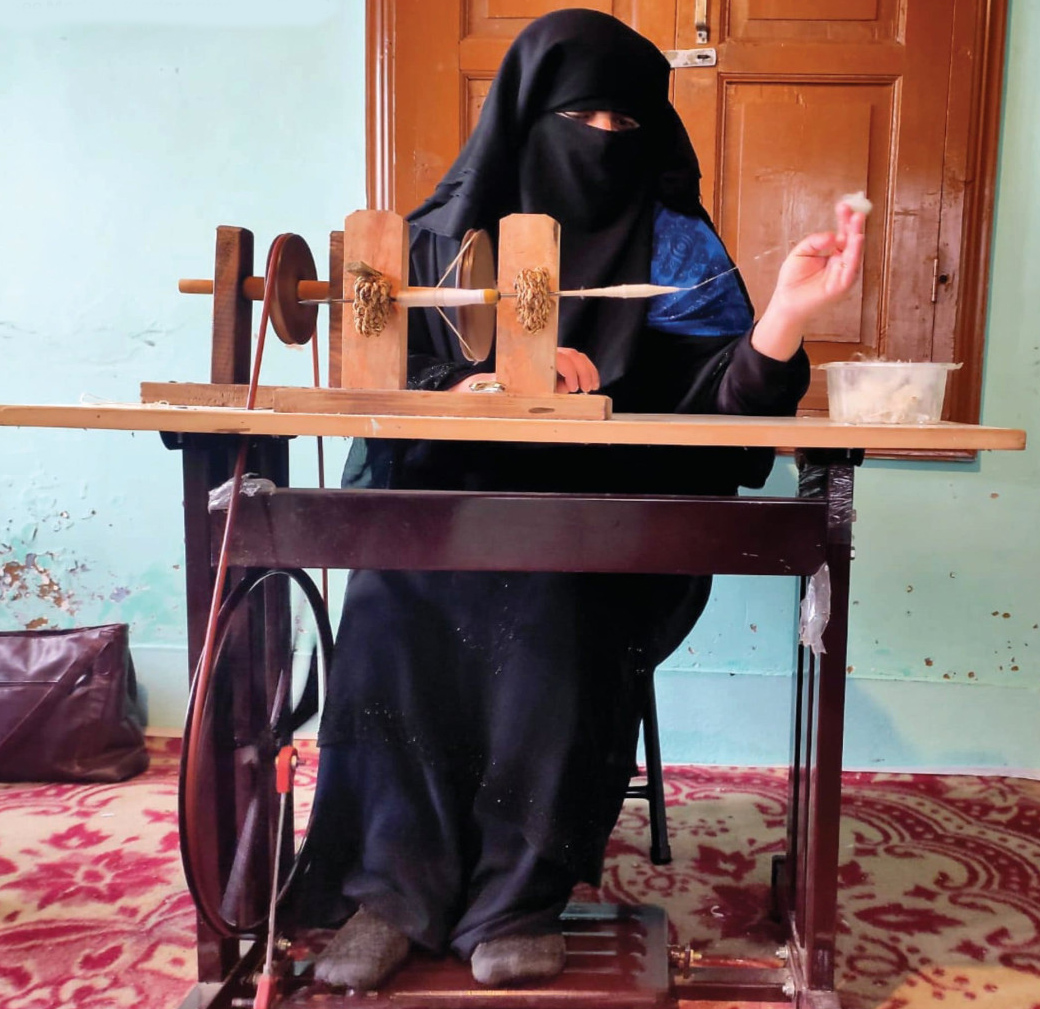
SRINAGAR: In a small room of a single-storied house, a 45-year-old single mother, Nargis who lives with her two children in Chanpora here seems jubilant as she places the much anticipated table-sized thread spinning machine in the corner of her room.
Unable to believe that the spinning wheel she had thrown away nine years back has returned to her house -in a new avatar with a promise of economic prosperity.
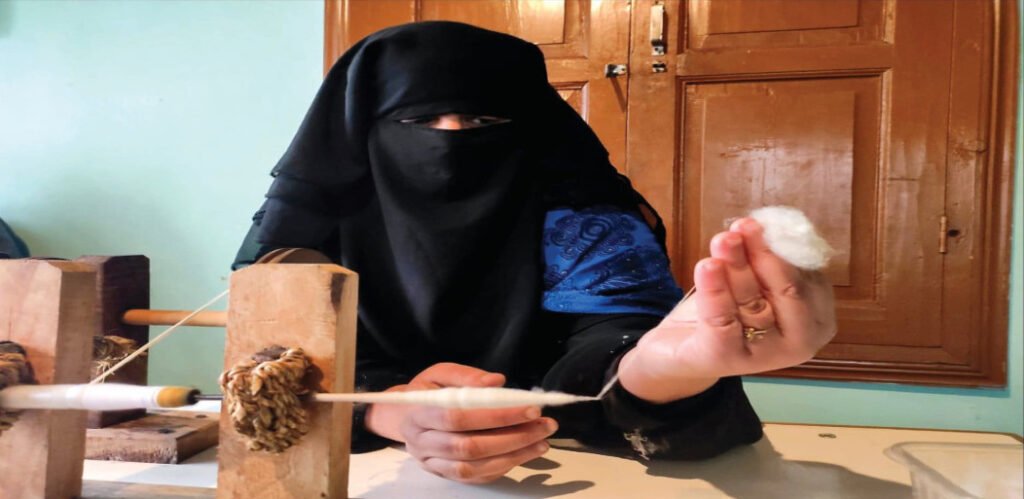
A modern spinning wheel, modern charkha or modern yinder as called in the local parlance is the latest innovation in Valley’s Pashmina industry that has off late rejuvenated the faith of Pashmina wool spinners in the craft.
The world-famed Pashmina shawls have been a hallmark of Kashmir handicrafts. And the role of women in powering this craft through their unmatched spinning skills is an open secret.
Many Kashmiri women particularly from Srinagar households have been spinning Pashmina and Shahtosh for ages. There are hundreds of legends from yore eulogizing the valor of women, who raised their families from income made from spinning yarn on charkha.

They say as lifestyles shift, so does the household expenditures. By at the turnaround of this millennium, most of these Pashmina wool spinners either hanged these charkhas over attic or send them to scrap for sitting on them meant meager returns. Like Nargis, most of such weavers had shifted to other works more profitable than the traditional spinning of Pashmina wool.
But then, the spinning craft is back with a bang.
And it’s essentially thanks to the group of scientists at the Sher-e-Kashmir Institute of Agricultural Sciences and Technology or SKUAST Kashmir, who developed the modern charkha, which has not only rejuvenated the hopes of spinners but the women who are using it claim to earn two to three hundred percent more than what they usually used to earn from traditional yinder.
“With the increased cost of living, to meet the two ends from a meager earning of Rs 30-40 per day from the age old yinder was impractical. So I had to shift from kataen kaem or hand spinning of yarn to some other feasible work almost thirteen years back,” said Arifa Bilal, a 45-year-old Pashmina wool spinner from old City of Srinagar. “But deep in my heart, I always missed that old yinder as the wheel had helped my mother… Fortunately, I came to know about its new avatar, got few days of training in handling this wheel and thanks to Almighty, I am able to earn about Rs 250 to 300 a day now,” added Arifa while sitting beside her charkha.
Introduced by SKUAST-K in 2022, the Modern Yinder is a pedal driven charkha fitted on the table. The pedal driven charkha is much easier to operate than the older wooden ‘yinder’ and has almost doubled the output for these women spinners.

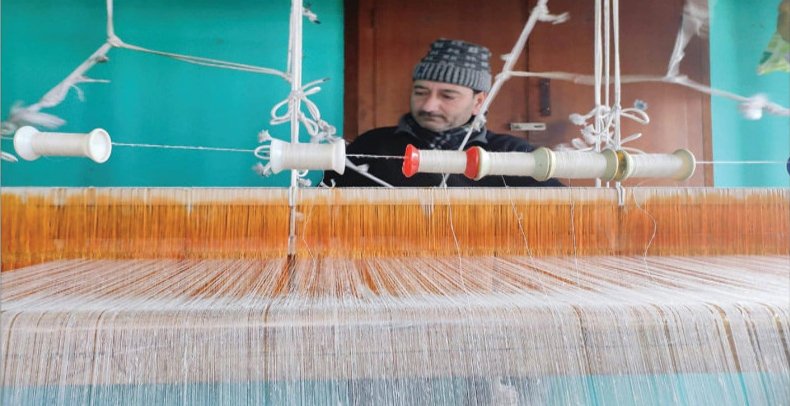
Dr Sarfaraz Ahmad, who was a part of SKUAST-K team that innovated the novel yinder said that the modern charkha has health benefits as well. “Earlier the women used to sit behind the traditional yinder but the modern charkha provides her comfort of sitting on a chair while spinning the wheel”, he told the Valley Observer.
Seconding Dr Ahmad, Sameena Akhtar, a newlywed woman from Srinagar said that given the design of modern yinder, she is able to operate it on ease despite “backache and disc issues.”
The redesigned charkha has been a game changer. It is attracting hundreds of women towards the trade. Many women who had left the spinning have resumed and earn more. A training centre run by a Pashmina dealer in Srinagar has trained hundreds of women so far in operating pedal driven new charkha.
“This pedal driven charkha has helped in increasing the output of hand spun Pashmina Yarn. Together at this centre, we have trained almost 200 women including young girls in operating the novel yinder,” said Ishfaq Qadri who runs the centre at his Me & K Pashmina House in downtown Srinagar. Qadri who is known for selling famed Pashmina Shawls to different parts of the world has so far distributed more than 40 modern charkha’s free of cost among the spinning community.
“Such technological interventions are definitely helpful in increasing both the produce as well as the income of weavers, which forms an essential ingredient in the revival of Pashmina industry in the valley,” he added.
Experts believe that the development is the beginning of an era of revival of once a hallmark of Kashmir- the hand -woven Pashmina shawl business.
Boosting the morale of hand woven Pashmina wool spinners in the valley, Government has also fixed the minimum selling price for one knot at Rs 2.5, which has given a further push to once the mainstay craft of women folk mainly from downtown Srinagar.
According to Mahmood Ahmad Shah, Director Handicrafts & Handlooms Department Kashmir, the craftswomen spinning hand woven Pashmina yarn play a pivotal role in the Pashmina craft and his department is trying its best to ensure the benefits of famed craft trickles down to every stakeholder.
As for the single mother Nargis, she spins the modern charkha to earn her livelihood like never before!