


NASIR YOUSIFI
CHANGTHANG: The cold desert where climatic conditions otherwise prevent establishment of even small a kitch-en garden, is now a hub of modern agricultural practices. Nyoma, the high altitude village in the Changthang region of Ladakh is now a home to a variety of vegetables and crops.
Changthang is located in the eastern part of Ladakh Union Territory. With altitude ranging between 4000 to 7000 meters above the sea level -the region is one of the highest inhabited in the world.
Lying in the rain shadow of Himlayan ranges, the area experiences cold and long winters and a very less plant production.
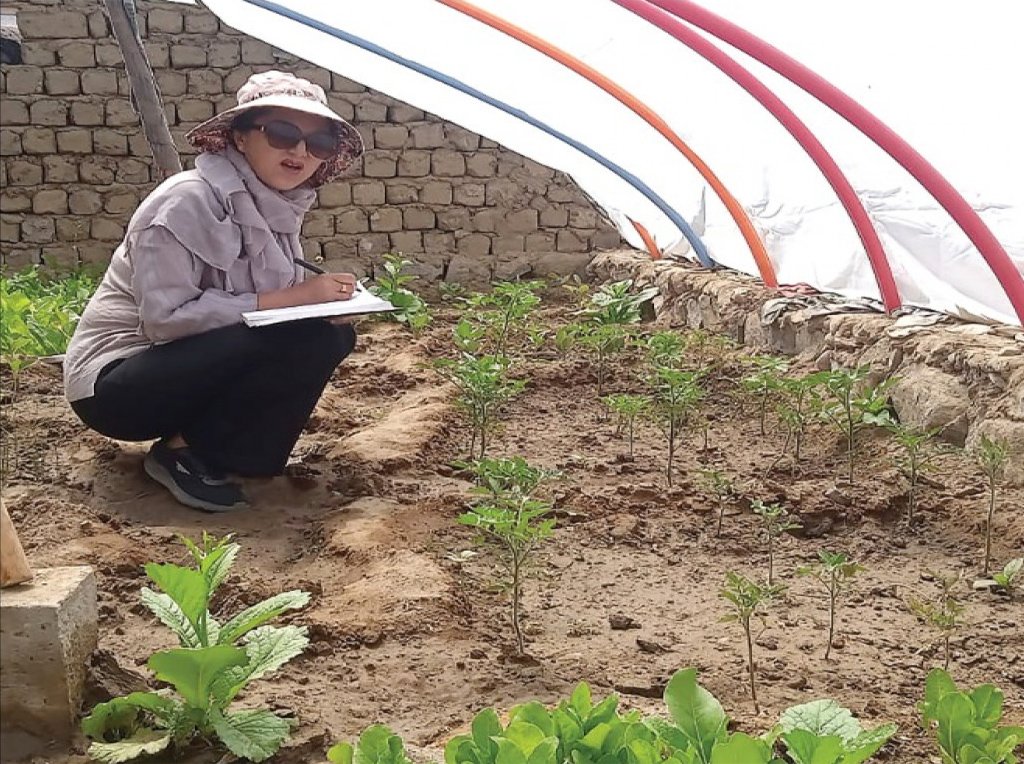
Amidst the gusty winds outside, a young woman is busy pruning the soil inside a low lying tunnel made mostly of mud bricks. Her tunnel, located at Nyoma, one of the world’s highest altitude village is one among the scores of tun-nels and green houses growing green vegetables.
Dechan Chogdol, a 35-year-old farmer grows thousands of cucumber in her farm. Interestingly, she also grows a variety of other green vegetables in few more tunnels built on an open patch of her ancestral land.
Nestled amidst the barren mountains, the high altitude Nyoma could only produce few varieties of arid crops like barley or turnip till a few years ago. But thanks to modern agricultural practices, the region witnesses now an agri-cultural prosperity.
“Nothing grows in Changthang, these words said in a high level meeting about the prospect of agriculture in Ladakh’s high altitude region, pinched me a lot,” recalls Dr Jigmet Yangchin, Programme Coordinator and a head of Krishi Vigyan Kendra SKUAST-K, Nyoma.
“As soon as I left the meeting , I along with others devised a plan for mass agricultural reforms in the area. With the support of the department, our unit launched a mass awareness campaign among the farmers about the benefits of agriculture. Since the people in the region are mostly nomads, to motivate them to use new technological inter-ventions was a challenge. But we succeeded in motivating many people including women to take onto modern agri-cultural practices,” Dr Jigmet explains.
Dr Jigmet says that the green house in Changthang looks quite similar to any other green house in plains, but in structure there is a vast variation. “These houses are made from clay bricks which are arranged in two layers. The straw is used to fill in a gap between the two layers of bricks which acts as an insulator. The roof is made from wil-low and popular branches… The green house in the region have south fencing,” the senior scientist says.

“These green houses are low cost structures, since they are made from locally available resources. These struc-tures are designed to trap maximum amount of solar energy.”
Besides green house, the farmers in the high altitude region also use low tunnel and trench techniques to grow vegetables.
In a small low lying tunnel in the same village ,Tsering Angmo, a 55-year- old women farmer spends most part of the day growing mushrooms. “Few years ago, I was only growing barley or occasionally turnip, I used to grow in this patch of land. But thanks to KVK, that now I am able to grow a cash crop,” the progressive farmer says while refer-ring to bags of sprouting mushrooms in a tunnel.
Traditionally the region has been growing barley, a crop that successfully grows in arid conditions. For the want of conducive climatic conditions, the vast patches of land amidst the mountains have remained untouched.
Records available with the Krishi Vigyan Kendra, Nyoma suggest that there are around 500 farmers in the area and about 2200 in the whole Changthang region. Since most of these farmers are nomads producing meat and wool, however, there are many farmers now who are growing green vegetables and other cash crops. A large number of women in the nomadic community are showing a special interest in modern agriculture.
In Muth, a model village which is considered a hub of cucumber cultivation, Sona Chungdol grows a large quantity of cucumbers. “Cucumber is not an only source of income, I grow around six varieties of tomato and one variety of brinjal in these farms,” says Chungdol, while referring to a group of green houses and trenches made on her farm land.