


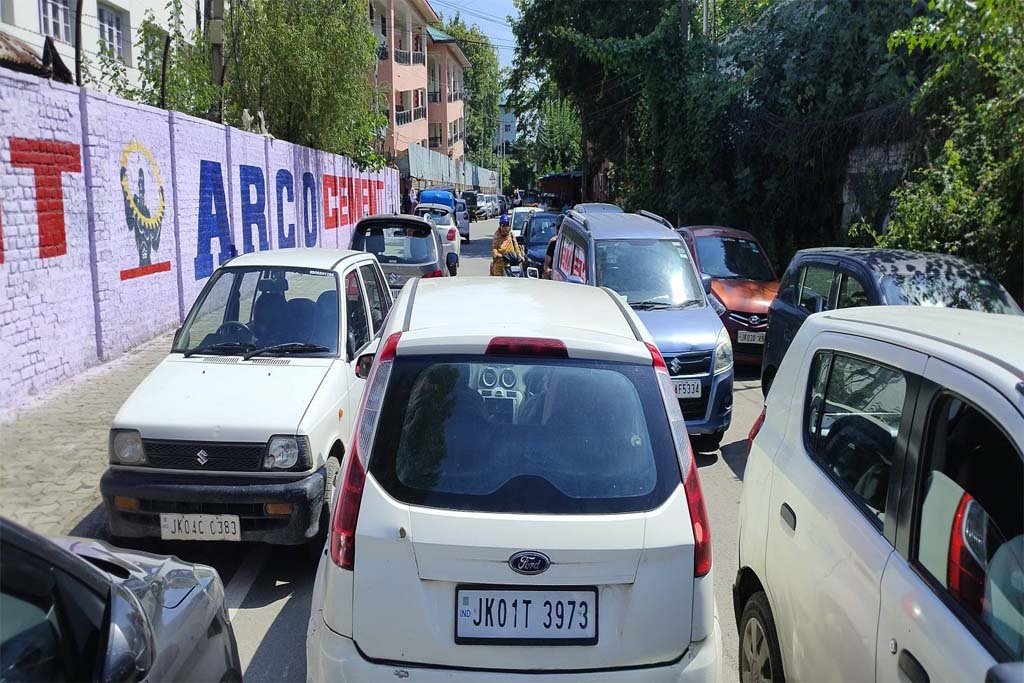
Citizens must understand that following rules is essential


Srinagar, the summer capital of Jammu and Kashmir, has long been celebrated for its serene Dal Lake, Mughal gardens, and breathtaking Himalayan backdrop. Its streets, historically meandering through ancient architecture and bustling markets, were once relatively calm and orderly. Today, however, they are a stark reminder that even the most beautiful cities are not immune to urban chaos.
What was once a manageable challenge has now escalated into a full-blown urban predicament. Residents spend hours in gridlock, emergency services are allegedly delayed, tourists are greeted with honking horns rather than tranquil waters, and economic activity suffers as productivity declines. At its core, Srinagar’s traffic crisis is not merely a logistical problem.
ANATOMY OF CONGESTION
Traffic jams in Srinagar are no longer occasional inconveniences; they are daily experiences. Intersections such as Lal Chowk, Jahangir Chowk, Hyderpora, Nowgam, Sanat Nagar, Rambagh, Bemina, and Parimpora have become notorious for gridlock. Vehicles halt in the middle of intersections, blocking other lanes.
Over the past decade, Srinagar has witnessed an exponential rise in private vehicles. Estimates suggest that the Valley’s vehicle population has now crossed nine lakh, with the majority concentrated in Srinagar city. Roads designed decades ago for far fewer vehicles are now under relentless pressure. The situation is further aggravated by illegal parking, roadside encroachments, and vendors occupying footpaths and shoulders, leaving little room for smooth movement. Vehicles are parked indiscriminately along roadsides, blocking lanes and leaving footpaths occupied by vendors, creating both inconvenience and safety hazards.
SIGNALS, SYSTEMS, AND FAILURES
One might assume that modern traffic signals and control systems would alleviate congestion. Unfortunately, Srinagar’s experience shows the opposite.
The problem is not merely technical but systemic. Without a functional, integrated traffic management system, Srinagar’s roads remain chaotic. Infrastructure is only as effective as the enforcement and planning that underpin it. Modern solutions, such as real-time traffic monitoring, GPS-based enforcement, and command centers, remain largely absent.
CULTURE OF INDISCIPLINE
Beyond infrastructure, behavioral patterns exacerbate the crisis. Lane discipline is nearly nonexistent. Minibuses, taxis, and private vehicles stop indiscriminately, often blocking intersections while picking up or dropping passengers. Double-parking is routine, and vehicles occupy footpaths meant for pedestrians.
IMPACT ON DAILY LIFE, ECONOMY
The consequences of Srinagar’s traffic gridlock extend beyond mere inconvenience. The economic impact is significant: deliveries are delayed, traders lose precious hours, and productivity across sectors is affected. Commuters, including students and office-goers, spend excessive time in transit, reducing both efficiency and quality of life.
Health consequences are equally alarming. Noise pollution and vehicle emissions increase due to idling engines, posing respiratory and cardiovascular risks. Emergency services — ambulances, fire brigades, and police — are slowed by clogged roads, putting lives at risk.
Tourists, who once flocked to Srinagar for its tranquility, are instead confronted with a cacophony of honking horns, overcrowded streets, and congested roads. The city’s image as a serene, scenic destination is eroded by its traffic reality.
PARKING BOTTLENECK
Illegal and unregulated parking is a silent yet potent contributor to congestion. Markets such as Lal Chowk, Batamaloo, and Karan Nagar are gridlocked because vehicles double-park on roadways and footpaths. Limited multi-level parking, and poor public awareness make roadside chaos the default choice.
Even proposed solutions, such as designated parking zones and complexes, have seen slow implementation. Until enforcement and alternatives are robust, illegal parking will continue to strangle Srinagar’s streets.
TECHNOLOGY: A PATH FORWARD
Modern cities leverage technology to manage traffic efficiently. CCTV monitoring, GPS tracking, e-challans, and centralized command centers help detect violations, monitor congestion, and optimize traffic flow.
Srinagar can adopt similar measures. A real-time traffic command center, integrated with city-wide signals, can track jams, deploy personnel dynamically, and enforce rules automatically. Technology not only reduces human error but also ensures transparency and accountability.
PUBLIC TRANSPORT LINK
A city’s traffic efficiency is inseparable from its public transport system. Srinagar’s transport network is outdated, and insufficient.
Investment in a reliable, modern public transport system is crucial. Electric buses, feeder routes, last-mile connectivity, and strict regulation of private carriers can reduce congestion significantly. Public transport must be safe, punctual, and comfortable to incentivize citizens to leave their private vehicles at home.
CIVIC AWARENESS
Traffic reform is incomplete without public participation. Citizens must understand that following rules — lane discipline, proper parking, using indicators, yielding to emergency vehicles — is essential. Schools, NGOs, and community organizations can play a pivotal role in instilling traffic etiquette in young drivers, creating a culture of compliance over time.
ADMINISTRATIVE, POLICY REFIRMS
- Immediate administrative actions can make a tangible difference:
- Ensure all traffic signals are functional, synchronized, and monitored.
- Strictly enforce regulations against intersection blocking and illegal parking.
- Develop clearly marked parking zones and public transport bays.
- Increase manpower and training in the Traffic Police.
- Deploy CCTV and automatic penalty systems for violations.
- Encourage carpooling and public transport use through incentives.
- Stagger office and school timings to reduce peak-hour congestion.
CONCLUSION
Srinagar has the potential to become a model of smart urban mobility in the Himalayan region. But achieving this requires commitment, coordination, and accountability. The challenge is significant, but so are the solutions. With political will, technological integration, public awareness, and disciplined enforcement, Srinagar can reclaim its streets and restore its image as a city that harmoniously blends natural beauty with modern urban life.
(Author is internationally known -a prominent freelancer, national TV debater, and columnist. Ideas expressed are his own. He can be reached at ahmadayaz08@gmail.com)
The views expressed in the article are of the author and do not, in anyway, reflect the opinion of the Valley Observer