‘Emphasis on civic responsibility, patriotism, role of education in Nation building’
SRINAGAR, NOVEMBER 07: Government College of Education (GCOE) here today organized a district level event to commemorate 150 years of the National Song “Vande Mataram”, celebrating its historical, cultural, and patriotic significance.
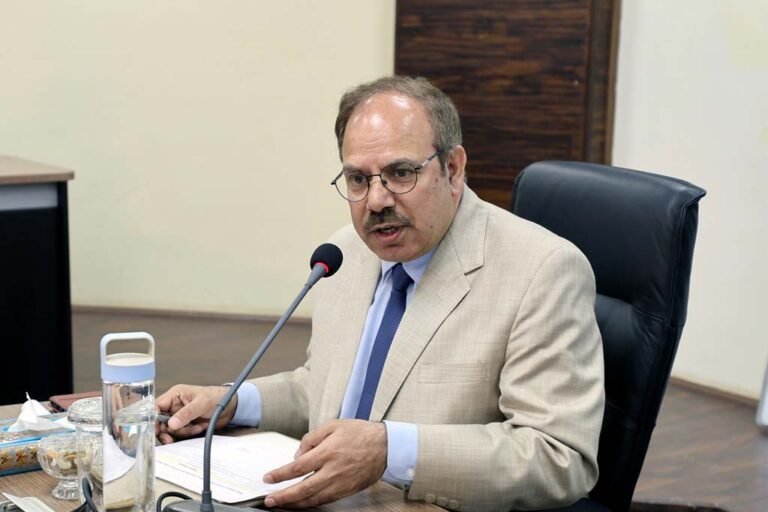
Additional Chief Secretary, Higher Education, Shantmanu was Chief Guest on the occasion.
Director Colleges, Prof. Sheikh Aijaz Bashir; CEO Srinagar, SDM East, faculty members and large number of students were also present on the occasion.
The programme commenced with the mass singing of “Vande Mataram” led by the Prime Minister, Narendra Modi, live streamed from the national event. This was followed by flag hoisting ceremony led by Additional Chief Secretary and singing of National Anthem thereby giving a dignified and patriotic start to the event.
After the flag hoisting, the Department of Music, Government College for Women, M.A. Road, Srinagar in collaboration with the cultural committee IASE presented a melodious rendition of “Vande Mataram.” Their performance created a deeply emotional and patriotic atmosphere in the auditorium.
Addressing the gathering, ACS Shantmanu emphasized on the importance of civic responsibility, patriotism, and the role of education in Nation building. He appreciated the efforts of institution in organizing such a meaningful event that connects education with cultural heritage.
Speaking on the occasion, HoD History, Dr. Abdul Rashid Sheikh gave an insightful talk on the history and significance of “Vande Mataram.” He traced its origin from Bankim Chandra Chatterjee’s novel Anandamath (published in 1882), its role in the Indian freedom struggle, and its enduring relevance as a symbol of unity and patriotism.
In her welcome address, Principal, Dr. Seema Naz highlighted the role of the institution for fostering unity, integrity, and spirit of patriotism among the teachers.
The Cultural Committee organized a patriotic song performance by Puran Bakshi and Muneer Shah (B. Ed 2nd Semester), showcasing India’s rich musical and cultural traditions. The songs resonated with the spirit of patriotism and collective pride.
The gathering also witnessed the live broadcast of the Honourable Prime Minister’s national address, as part of the nationwide commemoration programme. The Prime Minister’s message focused on national unity, cultural pride, and the values embodied in “Vande Mataram.” The address rekindled a sense of national pride and unity among the audience.
The formal proceedings concluded with a vote of thanks presented by Prof. Syed Shabana, Head of the Department of Hindi. She expressed gratitude to all dignitaries, guests, faculty members, and students for their participation and cooperation in making the event a success. The event was moderated by Prof. Lateef Ahmad Shah and the proceedings were documented by Prof. Shawana Manzoor.
Looms specially designed, offering back-rest and suitable seating arrangement
SRINAGAR, NOVEMBER 06: Close on the heels of distribution of 100 Modified Modern Steel Looms amongst the carpet weavers, the Union Ministry of Textiles has sanctioned ₹51.00 lakh for procurement and distribution of 100 more looms under the ‘Wool Processing Scheme’ of the Central Wool Development Board.
Each loom costing ₹51,000 has been specially designed by the Indian Institute of Carpet Technology (IICT), Srinagar, which provides a suitable back-rest and comfort seating arrangement for the weavers.
Sharing details in a press statement issued here today, Director IICT, Srinagar, Zubair Ahmad, thanked the Ministry of Textiles for sanctioning additional 100 Modified Modern Steel Carpet Looms amongst the active weavers for the current financial year 2025-26. “These looms are modified, keeping in view the health concerns of the weavers, who sit for long hours for weaving of the world-famous hand-knotted Kashmir carpets,” he stated.
Director IICT further stated that the Ministry of Textiles has already released the first tranche of ₹30.60 lakh for procurement of the looms. “Once the UC for first instalment is issued, the remaining two instalments shall also be released for procurement and distribution of looms amongst the intended beneficiaries,” he added.
The Department of Handicrafts and Handloom, Kashmir, has advised the interested carpet weavers to approach the offices of Assistant Director Handicrafts/ Handloom, in Kashmir Division for the completion of the requisite formalities.
Citizens must understand that following rules is essential
AHMAD AYAZ
Srinagar, the summer capital of Jammu and Kashmir, has long been celebrated for its serene Dal Lake, Mughal gardens, and breathtaking Himalayan backdrop. Its streets, historically meandering through ancient architecture and bustling markets, were once relatively calm and orderly. Today, however, they are a stark reminder that even the most beautiful cities are not immune to urban chaos.
What was once a manageable challenge has now escalated into a full-blown urban predicament. Residents spend hours in gridlock, emergency services are allegedly delayed, tourists are greeted with honking horns rather than tranquil waters, and economic activity suffers as productivity declines. At its core, Srinagar’s traffic crisis is not merely a logistical problem.
ANATOMY OF CONGESTION
Traffic jams in Srinagar are no longer occasional inconveniences; they are daily experiences. Intersections such as Lal Chowk, Jahangir Chowk, Hyderpora, Nowgam, Sanat Nagar, Rambagh, Bemina, and Parimpora have become notorious for gridlock. Vehicles halt in the middle of intersections, blocking other lanes.
Over the past decade, Srinagar has witnessed an exponential rise in private vehicles. Estimates suggest that the Valley’s vehicle population has now crossed nine lakh, with the majority concentrated in Srinagar city. Roads designed decades ago for far fewer vehicles are now under relentless pressure. The situation is further aggravated by illegal parking, roadside encroachments, and vendors occupying footpaths and shoulders, leaving little room for smooth movement. Vehicles are parked indiscriminately along roadsides, blocking lanes and leaving footpaths occupied by vendors, creating both inconvenience and safety hazards.
SIGNALS, SYSTEMS, AND FAILURES
One might assume that modern traffic signals and control systems would alleviate congestion. Unfortunately, Srinagar’s experience shows the opposite.
The problem is not merely technical but systemic. Without a functional, integrated traffic management system, Srinagar’s roads remain chaotic. Infrastructure is only as effective as the enforcement and planning that underpin it. Modern solutions, such as real-time traffic monitoring, GPS-based enforcement, and command centers, remain largely absent.
CULTURE OF INDISCIPLINE
Beyond infrastructure, behavioral patterns exacerbate the crisis. Lane discipline is nearly nonexistent. Minibuses, taxis, and private vehicles stop indiscriminately, often blocking intersections while picking up or dropping passengers. Double-parking is routine, and vehicles occupy footpaths meant for pedestrians.
IMPACT ON DAILY LIFE, ECONOMY
The consequences of Srinagar’s traffic gridlock extend beyond mere inconvenience. The economic impact is significant: deliveries are delayed, traders lose precious hours, and productivity across sectors is affected. Commuters, including students and office-goers, spend excessive time in transit, reducing both efficiency and quality of life.
Health consequences are equally alarming. Noise pollution and vehicle emissions increase due to idling engines, posing respiratory and cardiovascular risks. Emergency services — ambulances, fire brigades, and police — are slowed by clogged roads, putting lives at risk.
Tourists, who once flocked to Srinagar for its tranquility, are instead confronted with a cacophony of honking horns, overcrowded streets, and congested roads. The city’s image as a serene, scenic destination is eroded by its traffic reality.
PARKING BOTTLENECK
Illegal and unregulated parking is a silent yet potent contributor to congestion. Markets such as Lal Chowk, Batamaloo, and Karan Nagar are gridlocked because vehicles double-park on roadways and footpaths. Limited multi-level parking, and poor public awareness make roadside chaos the default choice.
Even proposed solutions, such as designated parking zones and complexes, have seen slow implementation. Until enforcement and alternatives are robust, illegal parking will continue to strangle Srinagar’s streets.
TECHNOLOGY: A PATH FORWARD
Modern cities leverage technology to manage traffic efficiently. CCTV monitoring, GPS tracking, e-challans, and centralized command centers help detect violations, monitor congestion, and optimize traffic flow.
Srinagar can adopt similar measures. A real-time traffic command center, integrated with city-wide signals, can track jams, deploy personnel dynamically, and enforce rules automatically. Technology not only reduces human error but also ensures transparency and accountability.
PUBLIC TRANSPORT LINK
A city’s traffic efficiency is inseparable from its public transport system. Srinagar’s transport network is outdated, and insufficient.
Investment in a reliable, modern public transport system is crucial. Electric buses, feeder routes, last-mile connectivity, and strict regulation of private carriers can reduce congestion significantly. Public transport must be safe, punctual, and comfortable to incentivize citizens to leave their private vehicles at home.
CIVIC AWARENESS
Traffic reform is incomplete without public participation. Citizens must understand that following rules — lane discipline, proper parking, using indicators, yielding to emergency vehicles — is essential. Schools, NGOs, and community organizations can play a pivotal role in instilling traffic etiquette in young drivers, creating a culture of compliance over time.
ADMINISTRATIVE, POLICY REFIRMS
Immediate administrative actions can make a tangible difference:
Ensure all traffic signals are functional, synchronized, and monitored.
Strictly enforce regulations against intersection blocking and illegal parking.
Develop clearly marked parking zones and public transport bays.
Increase manpower and training in the Traffic Police.
Deploy CCTV and automatic penalty systems for violations.
Encourage carpooling and public transport use through incentives.
Stagger office and school timings to reduce peak-hour congestion.
CONCLUSION
Srinagar has the potential to become a model of smart urban mobility in the Himalayan region. But achieving this requires commitment, coordination, and accountability. The challenge is significant, but so are the solutions. With political will, technological integration, public awareness, and disciplined enforcement, Srinagar can reclaim its streets and restore its image as a city that harmoniously blends natural beauty with modern urban life.
(Author is internationally known -a prominent freelancer, national TV debater, and columnist. Ideas expressed are his own. He can be reached at ahmadayaz08@gmail.com)
The views expressed in the article are of the author and do not, in anyway, reflect the opinion of the Valley Observer
Srinagar, November 3: Institute of Business and Policy Research (IBPR), Sher-e-Kashmir University of Agricultural Sciences and Technology of Kashmir (SKUAST-K), kick started a two-day inception workshop on “Federation Ecosystem for Rural Business and Service Hubs (RBSHs)” under the Holistic Agriculture Development Programme (HADP-04) from November 3-4, 2025 at the University’s Shalimar Campus.
The workshop was inaugurated by Ghulam Jeelani Zargar, Director, Horticulture Planning and Marketing, Government of Jammu and Kashmir, who graced the occasion as the Chief Guest. Prof Shabir A Wani, former Director, Planning and Monitoring, SKUAST-K, was the Guest of Honour. The event brought together a diverse group of experts, academicians, field officers, and representatives from emerging RBSHs across Kashmir to deliberate on building a robust, federated ecosystem to accelerate rural enterprise development and agri-business transformation.
In his address, Prof Farhat Ahmad Shaheen, Head, IBPR, and Principal Investigator, HADP# 04, emphasized that the Federation of RBSHs will act as a backbone for decentralized rural development, bridging primary producers with markets, services, and value networks. Presenting the Federation Framework Model, Prof. Shaheen outlined a hub-and-spoke approach to connect individual RBSHs with sectoral experts, agri-input manufacturing firms, digital service providers, and academic institutions to enhance efficiency and market outreach. He highlighted the importance of synergizing policy, practice, and grassroots entrepreneurship, stressing that “building dialogue between policymakers, practitioners, and rural entrepreneurs is crucial for transforming agricultural trade and service ecosystems.” He urged all stakeholders to focus on scalable, innovation-driven business models that empower youth, enhance livelihoods, and strengthen local economies through collaboration and enterprise.
Prof. Shabir A. Wani, in his remarks, lauded IBPR’s vision and leadership in conceptualizing the Federation Model as a scalable and replicable pathway for sustainable rural growth. He emphasized the need for evidence-based planning, integrated development strategies, and long-term sustainability models to empower RBSHs as self-sustaining, dynamic rural enterprises.
Addressing the participants, Shri Ghulam Jeelani Zargar underscored the transformative potential of RBSHs in reshaping the rural economy by enabling last-mile delivery of agricultural services, technology, and business solutions. He reaffirmed the Government’s commitment under HADP to foster entrepreneurial networks and promote institutional convergence among public agencies, private stakeholders, and rural communities.
Dr. Abid Sultan, Scientist, IBPR, and Workshop Coordinator, presented the detailed structure of the workshop, highlighting the thematic sessions on Federation Governance, Business Mapping, Knowledge Integration, and Capacity Building Strategies, and delivered the formal vote of thanks. Ms. Aiman Fayaz, Young Professional, HADP-04, coordinated the workshop proceedings.
The workshop reflected IBPR SKUAST-K’s strong commitment to transforming the agricultural marketing ecosystem by fostering innovation, integration, and rural enterprise development. It reaffirmed the institute’s vision of building a federated, market-led, and technology-driven rural economy under the HADP framework.
Director leads comprehensive monitoring in Srinagar
SRINAGAR, NOVEMBER 3: The Directorate of School Education Kashmir (DSEK) has reaffirmed its unwavering commitment to ensuring the smooth, fair, and student-friendly conduct of the ongoing examinations across the Kashmir Division.
In a proactive move to uphold transparency and excellence, Director School Education Kashmir, Naseer Ahmad Wani, today personally led a comprehensive monitoring exercise in Srinagar.
He was accompanied by Chief Accounts Officer, Syed Mubashirah, and Chief Education Officer Srinagar, Gh. Mohi-ud-din Bhat.
The Director visited several key examination centres including GHSS Kothibagh, Presentation Convent Higher Secondary School Rajbagh, High School Natipora, and High School Hyderpora, where he interacted with students and staff, reviewed arrangements on the ground, and extended his best wishes for a smooth and stress-free examination experience.
Speaking on the occasion, the Director said, “We are here to assure our students that the administration is fully dedicated to their success. Our top priority is to maintain a fair, transparent, and supportive environment. I appeal to all concerned staff to ensure a smooth and stress-free examination in every nook and corner of the Kashmir Division.”
Meanwhile, under the supervision of DSEK, multiple teams from the Directorate fanned out across all districts of the Kashmir Division to maintain strict vigilance and uphold uniform standards of conduct. Joint Directors visited several examination centres, including those in remote and far-flung areas of Kupwara and Anantnag districts, ensuring consistency and adherence to established protocols.
Additionally, Personnel Officer DSEK, Dr. Iqbal Hussain Mir, conducted a detailed review of arrangements across various centres in District Budgam, expressing satisfaction over the effective and disciplined conduct of the examinations.
The Directorate remains resolutely committed to maintaining transparency, discipline, and a student-centric atmosphere throughout the examination processes, ensuring that every student is provided a fair opportunity to perform to the best of their abilities.
CM Omar Abdullah lauds SBI’s gesture of solidarity, service beyond banking
JAMMU, NOVEMBER 3: A deputation of the State Bank of India (SBI) today called on Chief Minister Omar Abdullah at the Civil Secretariat, Jammu, and presented a cheque of ₹1.55 crore as a contribution to the Chief Minister’s Relief Fund.
The delegation was led by Jayant Mani, Deputy General Manager (Business and Operations) and Controlling Head for Jammu & Kashmir and Ladakh.
Chief Minister Omar Abdullah expressed his gratitude to the SBI employees for their generous contribution, describing it as “a noble gesture of solidarity and service beyond banking.”
He said the donation reflects SBI’s continued commitment to social responsibility and its deep bond with the people of Jammu and Kashmir.
KUPWARA, NOVEMBER 03: The Department of Fisheries Kupwara has undertaken a significant initiative by stocking Brown Trout fingerlings in the upper reaches of Mawar, Dringyari, and Kalaroose streams, which have been officially declared as trout streams under the J&K Fisheries (Amendment) Act, 2018.
The genetically improved eyed ova of Brown Trout were imported from Denmark under the Pradhan Mantri Matsya Sampadha Yojana (PMMSY) 2024–25 and were reared to fingerling size at the departmental hatchery in Kulgam before being released into the natural streams.
This milestone initiative aims to replenish and enrich natural trout habitats, ensuring the sustenance of fish biodiversity and promoting sport fishing in the region.
Pertinently, Brown Trout, a globally renowned sport fish, attracts anglers from across the world. Kashmir, known as the “Angler’s Paradise,” continues to host thousands of fishing enthusiasts every year.
In Kupwara, several anglers have already started visiting these streams to enjoy trout fishing in the pristine waters. Apart from recreation, trout angling contributes significantly to eco-tourism promotion and environmental conservation, while also encouraging responsible interaction with nature.
The Department of Fisheries has reiterated its commitment to strengthen sustainable fisheries management and promote angling-based tourism in the district.
Restoration of Darbar Move practice “a welcome experience,” rekindles Jammu city’s enthusiasm: CM
JAMMU, NOVEMBER 3: Chief Minister Omar Abdullah was today accorded a rousing reception by the people of Jammu on the first day of opening of offices in Jammu. The biannual Darbar Move, to be followed now onwards, marks the formal opening of offices in the winter capital.
As per the day’s schedule, the Chief Minister arrived at Shaheedi Chowk, Jammu at 9:15 AM, where he was warmly received and felicitated by the Jammu Chamber of Commerce, Residency Road and Rajinder Bazar Associations.
Thereafter, the Chief Minister walked towards Raghunath Bazar Chowk via Residency Road, greeting traders and citizens who lined the route to extend greetings and best wishes on his arrival.
At Raghunath Bazar Chowk, Omar Abdullah was felicitated by the Raghunath Bazar Association before proceeding on foot towards City Chowk, where he was received by members of the City Chowk Bazar and Kanak Mandi Bazar Associations.
Later, the Chief Minister was received at the Civil Secretariat, where he was presented with a Guard of Honour, marking the opening of offices as part of the traditional Darbar Move.
The Chief Minister inspected the ceremonial parade and interacted with officers and staff on the occasion.
Following the ceremonial reception, Omar Abdullah chaired a high-level meeting with the Council of Ministers and Administrative Secretaries to get an update on the functioning of various departments and assess the administrative preparedness following the move.
Addressing the meeting, the Chief Minister described the restoration of the Darbar in Jammu after a gap of four years as “a welcome experience” that has infused a wave of enthusiasm and happiness across the city and its adjoining areas.
He, however, underlined the challenges ahead, noting that the government is now at a crucial juncture where “actual ground delivery is expected.”
“All planning and discussion phases have been completed. It is now time to translate the decisions into tangible outcomes on the ground,” Omar Abdullah emphasised.
The Chief Minister directed all departments to focus on the timely implementation of projects already sanctioned and approved, ensuring visible progress at the grassroots level.
Acknowledging the financial constraints being faced, Omar Abdullah assured that the matter of limited resources “will be appropriately addressed.” He called for a balanced approach, urging officers to “ensure effective delivery while simultaneously curbing unnecessary expenditure.”
The Chief Minister also informed that a series of district-level review meetings have already been conducted in the Kashmir province and that similar interactions will now be initiated across the Jammu division to assess developmental progress and address public issues.
Chief Minister Omar Abdullah commended all departments for their coordinated efforts in ensuring the smooth and successful conduct of the recently concluded Assembly session.
SRINAGAR, September 26, 2025 : Professor (Dr.) Sheikh Ajaz Bashir, Director Colleges, Department of Higher Education, Government of Jammu & Kashmir, has announced the opening of admissions to Four-Year Undergraduate Programs (FYUGP) for the Academic Session 2025-2026 for 10+2 Biannual pass-out students. Admissions will be open across all Government Degree Colleges in Jammu & Kashmir starting from September 29, 2025.
Eligible candidates can register and apply online through the Samarth Portal at https://jkadmissions.samarth.ac.in. Students are advised to consult the Admission Counselling Centers of their preferred colleges to seek guidance and complete the admission process for the program of their choice.
Regular candidates who could not secure admission in earlier rounds are also eligible to apply during this period.
For detailed guidelines and eligibility criteria, candidates are advised to read the official notification available on the Samarth Portal.
Srinagar: In a moment of great pride for SP College Srinagar and the academic community of Jammu and Kashmir, Dr. Waheed Ahmad Khanday, Assistant Professor, Department of Chemistry, has been recognized among the worlds top 2% scientists by Stanford University, USA, for the year 2025.
Dr. Khanday has made significant contributions in the field of Chemical Engineering, with a particular focus on waste management, environmental safety, and water treatment technologies. His impactful research has earned him wide recognition at the international level. Over the course of his career, he has published more than 55 research articles in reputed journals, which have collectively received around 4000 citations, reflecting the global relevance and quality of his work.
Reacting to the achievement, the Principal of SP College Srinagar congratulated Dr. Khanday, stating:
It is a matter of immense pride for SP College that one of our own faculty members has been placed in Stanford University’s list of the worlds top 2% scientists. This recognition not only highlights Dr. Waheeds dedication and scholarly excellence but also underscores the potential of academic talent within college setups. His achievement will serve as an inspiration for faculty and students alike. On behalf of the college fraternity, I extend my heartiest congratulations to Dr. Waheed and wish him greater success in the years to come.
The recognition of Dr. Khandays work at such a prestigious global platform is being hailed as a remarkable feat, especially for a college-based scientist. It highlights the strong research culture being nurtured at SP College Srinagar and opens new horizons for collaborative research in environmental and chemical sciences.