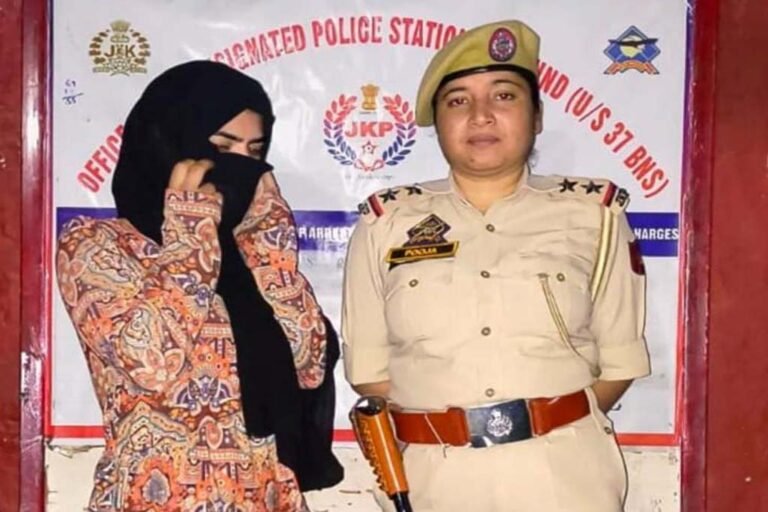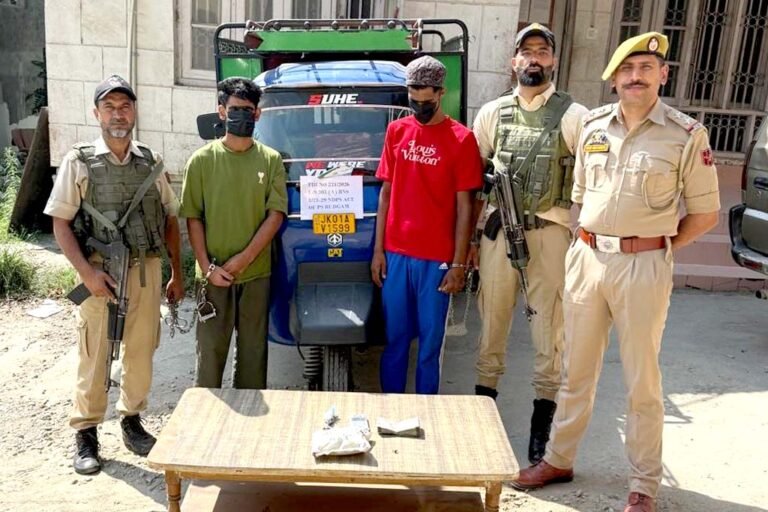
Kulgam, March 01: Acting tough against social crimes, Police in Kulgam have arrested 03 gamblers and seized stake money from their possession.
Acting on a specific information regarding gambling activities at Chirhama Mirbazar, a police party headed by Incharge PP Mirbazar raided the suspected gambling site and apprehended three gamblers. They have been identified as Zahoor Ahmad Ganie son of Ghulam Hassan Ganie resident of Zadoora, Bumthan, Manzoor Ahmad Lone son of Ghulam Mohammad Lone and Zahoor Ahmad Lone son of Mohammad Maqbool Lone, both residents of Lalipora Malpora.
Officers have also seized stake money of ₹4,440, three mobile phones and playing cards from the gamblers.
Accordingly, a case vide FIR No. 27/2023 under relevant sections of law has been registered in Police station Qazigund and further investigation has been initiated.
Persons found indulging in criminal activities shall be dealt as per law. Community members are requested to share information regarding the crimes in their neighbourhood with the local police units.
Sopore March 01: Police in Sopore have solved a burglary case by arresting 02 accused persons involved in the commission of crime.
On 28/02/2023, Police Post Putkha received a complaint from BDO Sopore stating therein that during intervening night of 27th-28th/02/2023, some unknown burglars broke open the lock of Panchayat Ghar at Hygam Sopore and stole solar batteries.
Accordingly, a case vide FIR No. 12/2023 under relevant sections of law was registered at Police Station Tarzoo and investigation was initiated.
During the course of investigation two suspected persons identified as Ishfaq Ahmad Dar son of Nazir Ahmad resident of Palhallan Pattan and Muneer Ahmad Dar son of Nazir Ahmad resident of Haritar Rakh Hygam were zeroed on and subsequently called for questioning. After thorough questioning, officers learnt about their involvement in the commission of crime. Stolen property was also recovered from their possession.
They have been arrested and shifted to police station where they remain in custody.
Community members has lauded the efforts of police for cracking/solving the case within the shortest possible time. Our consistent actions shall assure community members that Police has resolved to act tough against individuals involved in any kind of criminal activities.
SRINAGAR, MARCH 01: The Cultural Unit Kashmir, Department of Information and Public Relations J&K today celebrated Zero Discrimination Day at Joint Directorate of Information Kashmir.
Speaking on the occasion, Cultural Officer Kashmir, Burhan Hussain said that Zero Discrimination Day is observed every year on 1st of March with an aim to recognise everybody’s right to a complete and fulfilling life to lead it with respect.
Zero Discrimination Day contributes to creating a worldwide solidarity campaign to abolish all forms of discrimination.
Organisations like UNAIDS, which fight intolerance against persons living with HIV/AIDS, take special note of the day.
AECO Syed Shakeel Shan while conducting the proceedings said that the day is celebrated for the right of everyone to live life with dignity. It highlights how people can become informed about and promote inclusion, compassion, peace and create a global movement of solidarity to end all forms of discrimination.
A thematic cultural program was also arranged on the occasion. Cultural Unit Artist, Suhail Mohi-ud-Din enthralled the audience by his mesmerizing voice.
All the employees and officers of Joint Directorate of Information Kashmir attended the function.
SRINAGAR, MARCH 1: With an objective to promote Prime Minister Narendra Modi’s vision of ‘Vocal for Local’ and an emphasis on ‘Atmanirbhar Bharat’, Jammu Kashmir Trade Promotion Organization (JKTPO), under the aegis of the Department of Commerce & Industry, in association with the Trade Promotion Council of India (TPCI), organized an international Buyer-Seller Meet (BSM) for local agricultural & food processing sector of J&K.
Addressing the forum virtually, Chief Secretary, Dr Arun Kumar Mehta highlighted the improved scenario of law-and-order and thriving business ecosystem within J&K. Chief Secretary said that J&K is more peaceful now, digitally connected, with improving mobility infrastructure resulting in reducing logistic challenges faced by exporters. He highlighted that the rail connectivity to Srinagar would be a reality next year. He maintained that J&K is focusing on improving ease of doing business and expects to be placed within top ranking States/UTs by DPIIT. He called for more such Buyer Seller Meets in coming financial year for promotion of trade and investment and said that such meets should show concrete results in terms of business transactions.
He spoke about harnessing the immense potential of produce from Kashmir by extending market access and emphasized the world-class quality of local products and said that the craftsmanship of JK is unmatchable.
He further assured the buyers from different countries that they can seek any help they genuinely need from government of Jammu and Kashmir and become a partner in the growth story of Jammu and Kashmir.
Principal Secretary, Department of Industries and Commerce, Prashant Goyal, in his special address to the buyers and sellers present in the event underscored the contribution of Agriculture in the development of the economy of J&K wherein around 70% of the population residing in rural areas directly or indirectly depends on this sector for their livelihood and employability. He also highlighted the progressive, competitive & investment friendly policies of the Union Territory of J&K.
He highlighted that the New Central Sector Scheme (NCSS) package announced by central government is one of the best financial incentive packages offered by any State/ UT in India with a high return on investment and less input cost. In addition to the incentives offered by the New Central Sector Scheme, the investor can avail incentives offered by industrial policy & the other sectoral policies notified by the government.
Divisional Commissioner Kashmir, Vijay Kumar Bidhuri complimented the efforts of JKTPO for the BSM and emphasized on the importance of conducting more such events in near future. He also highlighted the importance of field level investments in the agriculture sector which will enhance the value of the local Agri products from J&K through processing. He also recommended for feedback from both buyers and sellers so that further improvements can be done in the industrial ecosystem of J&K.
Earlier, Khalid Jahangir, Managing Director, JKTPO gave opening remarks and welcomed the Buyers and sellers on the occasion. He said that J&K’s food and agro based products are famous across the world and urged the buyers to procure these products from authentic and genuine sellers of J&K. He revealed since J&K for its diverse agro climatic conditions is blessed with range of niche products that have great export value simultaneously.
The forum was briefed about USPs of products being displayed viz. Honey, Saffron, Basmati Rice, Walnut, Fresh fruits, processed food like juices, jams, bakery etc.
Also, JKTPO is participating and organizing in various trade fairs, exhibitions and Buyer Seller meets besides providing marketing and business opportunities to the sellers, as was given out during this event.
Deputy Director General, TPCI Sandeep Das, gave vote of thanks for the event. In his closing remarks, he said that JKTPO and other relevant departments from J&K should work on building supplying capacity of the sellers to meet the needs of buyers and get bulk orders in near future. He also suggested that sellers should work on improving quality and packaging as per the standards and parameter set by different countries.
It was said that the BSM contributed immensely towards forming new strategic partnerships and assistance in developing market linkages, business leads and networking for boosting trade and exports of J&K Agri& food Processing products.
During this event more than 500 leads were generated which are expected to be converted into potential orders. Above 120 sellers including Food processing units, entrepreneurs, FPOs from Jammu & Kashmir participated in the event.
Director Industries and Commerce, Kashmir, Saloni Rai was also present on the occasion along with other senior officers and functionaries of the department.
Srinagar: While holding it with his left hand, a pheran clad man gradually spins the flower vase as he rolls his brush on the artifact repeatedly. After hours of the intricate painting, the plant bearing tufts of rose drawn on the vase looks real.
Aga Syed Sajad Hussaini Hamdani, a man bestowed with magical fingers is an accomplished Paper Machie artist from Zadibal area of Srinagar. A son of respectable and learned personality Aga syed Ali Hussaini Hamdani from Khanqah-e-Sokhta Nawakadal in Srinagar, Sajad has been tinkering with colors and brush since his childhood. Even though Sajad’s parents wanted him to become an engineer, his unflinching love with colors and designs landed him into the world of Paper Machie.
“Whenever my parents entered into my room, where I was supposed to study school books they always found me doing drawings. Once sarcastically, my father grabbing my hand took me to a nearby Paper Machie workshop in the area. To the surprise of every one at home, I never opened the school bag onwards while embracing the craft as a lifetime career”, says Sajad while recalling the incident which changed the course in his life.
After the incident , there was a no time to look back. While his peers and class mates were making it to the colleges and universities, the natural artist in Sajad was being groomed at the hands of Kashmir, best artist Haji Mirza Muhammad Saleh from the valley. I was lucky enough to spend 14
years of my life and apprenticeship with such a great teacher . Through his knowledge , He taught us to be the change and that change can be conceived through the brush.
Infusing life into the artificats for more than 30 years now, this artist from Down Town has produced thousands of rare designs in the craft winning respect and accolades through out the globe. Having fetched to the demands of Valley’s renowned craft businesses like Suffering Moses, Kawoosa Art and Bony Arts, the rare designs made by Sajad are valued world over and within the domestic circles too. From Mehraab of Masjid-e-Salman Farsi, Budgam Imambara , hotels in Srinagar to Mumbai hotels, the paper machie panels designed and painted by this artist soothe thousands of onlookers and visitors.
Sajad has won laurels for his unmatched work across the globe. I still use to get orders from the customers from different parts of the world. According to Sajad, the demand for his work has increased within the country also. Off late, lot of people from different states of India have shown keen interest in the possession of paper machie artifacts. There is a good scope for growth, if a person treads on it professionally, says the artist while deliberating upon the career opportunities for the youth in this field. Initially I used to deliver my orders to few showrooms and businessmen operating in some European countries only. But now, there is a good demand for the art within in the domestic circles. Only a days ago, I received a call of appreciation from one of my customer in Mumbai. The trade needs patience and dedication. Apart from the time, youth who want to be in this craft should bear in mind the principle of honesty and preservance, As both pays in the long run. I ask the youth to come forward and embrace the ancestral craft, as it is full of opportunities and avenues keeping the changing lifestyle and taste of the people in mind.
In these days to reach out to the world is a not any big task. With the help of a social media , any artist can put his work on display for the world audience and earn livelihood as well as much needed encouragement.
Recently , Sajad’s magical fingers handed him a job in one of the reputed universities of the valley. In th year 2018, He was appointed as senior skill instructor by Design Innovation Centre of Central University Kashmir. Posted presently at Islamia College Srinagar, Sajad grooms hundreds of new hands in to the world of Paper Machie.
Though the handicrafts industry in the valley has taken a severe hit from past 30 years, recent enlisting of Srinagar among the creative city network by UNESCO for its unique crafts and art world coupled with a rejuvenated push of the authorities to promote and curate the heritage art of Kashmir has instilled a ray of hope among the artistic fraternity in the valley. According to Sajad, the government as wel as people should put concerted effort to encourage and promote the art in the valley. Sajad believes that like other parts of the world, the community should celebrate and observe the artisans day in Kashmir.
SRINAGAR: Come winters and annually thousands of migratory birds visit Kashmir. But not all of them are lucky enough to enjoy the hospitality of their favorite habitat –the wetlands as many such winged visitors get poached.
Braving the freezing cold of January, 12-year-old Farheen stealthily opens the window of her room to experience the soul soothing aura of central Kashmir’s Hokersar wetland, which lies just a few yards away from her house. Hoots, chirps and echoes produced by flock of birds is never less than a soulful treat for her or any nature lover.
From Water Ballards, Coots, Pintails and Teals to Shovellers, Gadwals, Tufted Ducks, Graylag Geese, Wigeon, Pochards and others, every winter thousands of birds take a long flight to comparatively less colder Kashmir wetlands from colder habitats in Siberia, China, parts of Europe and even Australia.
This annual migration, which lasts for about six months from October till March in the valley is always a treat to witness for any nature enthusiast, in particular the bird lovers.
Pegged between five to seven lakh, these migratory birds land in Hokersar, Hygam, Prichal, Shallabugh, Wullar and Dal Lake, the wetlands considered as a feeding ground for these birds.
Feeding on naturally available food present in the form of insects, worms and fish, the hovering of these migratory birds making patterns in the skies attracts attention of many birders and nature enthusiasts.
“The birds are a prize to watch. Watching thousands of birds gliding up and landing down is always a momentous sight,” said Farheen.
However, after flying thousands of kilometers many of these winged guests only land in a deathtrap, as they get killed at the hands of poachers before their return.
Despite the government ban on poaching and strict vigil by the government forces, killing of the birds goes unabated in and around the wetlands of Kashmir. Ducks, Geese, Swans to Mullards, for poachers all are in the target list.
Few years back, the Sher-e-Kashmir University of Agricultural Sciences and Technology or SKUAST Kashmir, under an initiative to study the migration patterns of migratory birds in Kashmir wetlands, fitted PTT(Platform Transform Terminal), a satellite based tracking device on many birds to track their movement.
To every member’s astonishment in the research team, the results were shocking.
According to Dr Khursheed Ahmad, Principal Investigator, the track of many such birds fitted with PTT was lost within few weeks as the device either stopped to send signal or signal went stagnant.
“For a stagnant signal, one can assume that the bird has suffered a natural death but if it goes off altogether, there is every likelihood that the bird has been poached,” Dr Ahmad told Valley Observer. “Our team met with cases where poachers had damaged the devices after catching or killing the bird.”
Not only guns, people use traditional traps and other hunting techniques to catch the winged visitors.
Occasional bangs in late evenings and the early mornings in deeper belts of the paddy fields are allegedly a “normal” for the people living around Shallabugh and Rambergarh areas, the villages marking the boundary between the capital city of Srinagar and Baramulla in north Kashmir.
“Since these areas are close to Hokersar wetlands, many birds visit these paddy fields for food and presumably get killed by poachers,” says a resident of Rambergarh Srinagar.
Admitting the poaching of winged visitors outside the protected wetland areas, Sajad Ahmad, Range Officer, Wildlife says that most of the poaching takes place outside the protected areas of wetlands, as the birds fly towards paddy fields and other cropping lands for the easy availability of feed.
“It is during these flights outside the protected areas, they get easily killed, as the poachers find it very easy to shoot them outside protected areas,” added Ahmed.
The Jammu and Kashmir Police are also keeping a strict vigil on the poachers. Some months ago, a person accused of poaching was arrested.
Poaching mainly takes place for adventure or money. It’s largely believed that the poached birds are secretly sold for around Rs 1,000 “per prey.”
Ironically, the place globally famous for hospitality –Kashmir isn’t that hospitable towards the winged visitors, who visit the Valley unmindful that their long flight could be the last!
SRINAGAR: Creating novel designs and adapting to changing trends, Valley’s willow wicker artisans rise to the occasion to keep the age old willow wicker basketry relevant in Kashmir.
After sharpening their tips, a man carefully chooses reeds from a bunch of wickers in front of him. One-by-one, he soon weaves them onto a wooden frame. Seemingly after hours of intense thought process and sheer display of intricate skill, Ghulam Ahmad, a 52-year-old wicker worker carves these wicker reeds into a beautiful basket at his residential workspace in Ganderbal’s Kachan village. The area is known for its age old craft- Kaeni Kaem or willow work in local parlance.
Kaeni Kaem
Locally also called as Shaakhsazi, the willow-wicker work is a handicraft involving primarily weaving of baskets from willow reeds. Remote villages like Umerher, Kachan, Shallbugh in Central Kashmir’s Ganderbal are the traditional hub of willow wicker-work in Kashmir.
From somewhat pliable slender twigs to decorous creations, the willow wicker undertakes an interesting journey.
“After cultivating willow twigs, they are harvested and arranged into bunches according to their length and width. Then each bunch is boiled in a large boiler. One by one each twig is then peeled and arranged in a bunch arranged in lawns and open spaces for sun drying,” says Mushtaq Ahmad, a willow grower from Ganderbal while narrating the process involved in willow-wicker harvest.
The wicker reeds used as a primary raw material in the age old cottage industry are cultivated in abundance near wetlands in Ganderbal.
Most of the harvest units, the majority of which are located in Umerher village are labour intensive, carrying out wicker processing manually. From here, the naturally brown coloured wickers find their way into large number of households in Shallabugh and Kachan villages, where willow-wicker craftsmen weave them into a range of products primarily the baskets, vases and kitchenware.
But till a few years ago, in the absence of any takers, the traditional basket makers were left in lurch.
The Depression
Baskets, flower vases, chairs, trays and Kangri are the significant willow-work products made in the valley. People in valley have been traditionally using these items since ages. However, the availability of comparatively economical fancy and polished Chinese products replaced the traditional wicker products over the years.
“As the markets were flooded with the trendy products mostly machine made from China, the taste of people too changed. Most of the people discarded the use of the traditional basketry items,” says Zahoor Ahmad Wani, a basketry shop owner from Srinagar. “There was a time when, Kangri, a traditional firepot used during winters in the valley was the only item in demand.”
But thanks to sharp wit of a group of artisans from Central Kashmir’s Shallabugh and Kachan villages who have not only sustained the art but are successfully passing it over to newer generations.
A fresh beginning
Leave the willow décor aside, few years ago apart from making Kangris and few baskets, there was almost no work for the Kashmir’s willow-work craftsmen. This was the time when Kadam, an NGO came to the rescue of Kashmir’s traditional basketry craft. Kadam not only mentored the craft, it helped the artisans to craft market driven designs from wicker through in person trainings.
“What we could make was only the traditional designs and products. However, after getting training from Kadam, our way of work has changed. Our designs have changed completely. Our products are now market driven,” Ghulam Ahmad told the Valley Observer.
“The trainings have been much beneficial in grooming our skill. Our products now match the international standard and off late there are many orders from international buyers too. At a time our younger generation was reluctant to learn the craft but for the last few years, lot of youngsters have shown their interest in this traditional craft and have infact taught it,” added Ghulam Ahmad while giving a final shape to willow drawer for Sofa.
The artisans from the village are now producing a wide range of products which include basketry, kitchenware, home décor, plantery, lamp shades, trays, wall plates, cradles, home utility and even sofas.
The technical intervention from Kolkata-based NGO facilitated by government has helped in bringing the artisans together to revive the age old rural craft in the valley.
According to Imtiyaz Ahmad, Cluster coordinator from Kadam, the government is really working in close coordination with the organizations to uplift the craft and to have an impact. “Our approach is twofold- one, to upgrade the skill of local artisan community related with the trade and two, to facilitate the market access.”
“We are continuously upgrading and reaching out to artisans through several training modules . So far a large number of artisans particularly the willow-wicker craftsmen from Ganderbal have participated and benefitted from this programme,” he said. With new push for the craft and the production of cheeky designs, the Kashmir willow-wicker products have an easy access to global market platforms like Myantra now.
SRINAGAR: Braving the biting cold, a middle-aged fisherman, Mohammad Sultan starts his day in the wee hours only to ensure that he returns home by noon to prepare one of the cherished winter delicacy from his days catch –Phaire or smoked fish of Kashmir.
Back home, his wife Saleema carefully cleans the larger sized fish in a tub. After cleaning the stock, she slightly tilts the tub to let the water drain out. At a few meters, her husband, Sultan arranges the heap of special dry grass in layers to make a grassy platform in their backyard at Central Kashmir’s Anchaar area in Srinagar.
The husband wife duo places the cleaned fish on a platform of grass and torch it to produce flame, smoke and heat. In a split of time, a prized catch gets engulfed in fire and smoke. After hours of slow flame and dark smoke treatment, Kashmir’s prized winter delicacy, Phaire is ready for sale.
Phaire
A fish partially roasted in smoke and flame is widely consumed by Kashmiris, mainly during winters. Cooked with Haakh or collard greens, tomato, raddish, lotus stem or dried brinjal, the Phaire does not only fill the Kashmiri kitchens with aroma but also satiates the “gastronomical sense of every food lover.”
During winters, a traditional dish ‘Phaire Haakh’ made from smoked fish and collard greens is vogue in traditional Kashmiri kitchens.
“This is my favorite form of fish. My children are also fond of it. We usually wait for winters to come to eat this fish”, says Mymoona Akhtar, a middle aged woman from Dalgate area while buying the smoked fish at Nowhatta in Srinagar.
Mymoona is a not the only customer. Another woman in her fifties, Haleema standing besides Mymoona also waits for her turn to get hold of her pack.
The making
The process of making smoked fish requires efforts of many people and is quite interesting in itself. The fish are first caught usually from the Dal or Anchar lake, then the women who are expert in cleaning it, wash and remove the waste part. After washing, the fish are laid down on the wild dry grass interwoven loosely shaped in the form of platforms and then dried for a while after which the grass is torched to smoke the fish on it.
When the fish becomes dark brown in colour and are properly smoked these fish are collected in a willow trays or baskets and then sold in the market.
Mostly the women sell the Phaire in the market in traditional willow baskets. Interestingly they also play a significant role in the making of smoked treat.
“My wife and daughter help me in smoking the fish for weeks together. While I usually catch some stuff myself for days together and buy the bulk of it from the fishermen from Dal lake side, my wife and a daughter engage in the collection of a special dry grass,‘naar gaase’ from nearby wetlands used in smoking the fish,” said Sultan.
Sells like hotcakes in cold
The demand for the smoked fish increases during winters. There is a common belief that the winter delicacy is a source of warmth in the colder months of winter. The same is reflected in the increased sale of the specially made fish.
Mohammad sultan has been in the smoked fish trade for decades. “I have been smoking the fish since my youth. I have learned the art from my ancestors. Though its demand diminishes during summer, my sales increase exponentially throughout the winters.”
Despite availability of fresh foods throughout the year, the taste and cultural legacy keeps its popularity afloat.
Cultural Icon
Despite round the year availability of fresh food in the valley now, unlike the past when the people had to bank mainly on dried vegetables during winters, the culture of relishing smoked fish still prevails in the valley.
Many believe that it “is the taste and cultural significance of this winter delicacy which lures the people for this traditional feast.” Often, many people still invite nears and dears for its feast.
“A friend of ours is visiting us tomorrow. So we decided to prepare Phaire Haakh, a traditional winter treat for him, as he has returned after a gap of two years from a gulf country,” said Tasleema while buying smoked fish from Saraibala market in Srinagar.
“Firstly I will remove the burned skin from the fish, clean them thoroughly and then mix the stuff with a blend of spices and Haakh,” Tasleema added while explaining the preparation of Phaire Haakh in Kashmir kitchens to the Valley Observer.
Amidst a variety of food including exotic pasta, pizza and mommo being sold in Kashmir, the traditional Phaire stands distinct as it continues to be a cherished winter delicacy in the valley.
Srinagar: Zaitoon Akhtar, a 42-year- old woman from Devsar hamlet in south Kashmir’s Kulgam carefully segregates the dried brinjals from the long thread like slices of sundried gourd before the local vegetable dealer weighs the stuff on his handheld balance and negotiates the deal.
Every year Zaitoon sundries the surplus produce from her vegetable garden and sells it during winters. “I have been making Al Hache, sundried bottle gourds and wangan hache dried brinjal slices for several years now. While I use some of the dried stuff in my kitchen, I am able to sell the rest of it to a dealer for good amount, as there is always a good demand for these dried vegetables in the market during winters,” she says while showing a tangled mass of Al Hache or sundried bottle guard.
About 90 kilometers away, Shahida Bano from Chadoora Budgam in central Kashmir has a dozen odd transparent bags filled with dried vegetables hanging on the attic of her multi-storied house. “During summers there is surplus production of vegetables in our vegetable gardens. Since the price of the same is very less due to surplus supply in the market, I prefer to sundry the surplus vegetables and sell them during winter months for a good return,” says middle-aged Shahida seconding Zaitoon.
Be it a sliced brinjal, laced gourd, tomato chops, turnip halves, their sundried form is destined to be a part of Kashmiri cuisine in almost every household, scenting the surroundings with peculiar aroma and taste during winters with -Hokhsyun or sundried vegetables.
With the demand from every nook and corner of the valley, the sellers of the dried delicacies dot almost every major market in the Kashmir towns and cities. “I have been selling these vegetables throughout the winters for many years now,” says Fayaz Ahmad, while standing besides the mass of dried stuff, put for sale on a push cart adjacent to famous Jamia Masjid at Srinagar’s famous Nowhatta market in congested downtown.
Zaid Ali/VO
Asserting, though seasonal in nature, there is good demand for these edibles during winters, Fayaz says, while selling the slices of Ale Hache to a customer.
There are many customers from places like Kargil, Leh and Jammu as well. Kashmiri Pandit community in Jammu is also fond of Hokhsyun. “On an average, I send a consignment weighing hundreds of kilograms, comprising of dried veggies to these places by the end of autumn every year,” says Bashir Ahmad Dar a Hokhsyun dealer from Noorbagh area of Srinagar.
Lesser movement of people during winters, lack of proper agricultural activity and peculiar geographic location promotes the use of dried veggies in the region.
As the valley witnesses a good production of locally grown vegetables like bottle gourd, brinjal and tomato in summers, there is a tradition of sun-drying the surplus for the use in harsh winters. During the months of July and August, there is large scale production of gourds, brinjal and many other vegetables owing to increased trend of kitchen gardening and hybrid variety of seeds in the valley. “Growers or households, usually dry up the surplus produce for the winter use,” says, Ajaz Hussain, Agricultural Officer, from Jammu and Kashmir Agricultural Department, posted in Srinagar.
It is not only turnip, gourd, tomato and brinjal which are sun dried in large quantities, but people also sundry lotus stem, fish, pepper, spinach and dandleon for consumption in winters. Though most of the vegetables are available in the valley throughout the year, some vegetables and fruits like gourd and pear are mostly dried as they are not easily available in the market during winters.
Consumption of dried veggies has been a part of the Kashmir’s culture since ages. Climatic conditions, geographic location and its unique culture are among many contributing factors as to why the people in this part of world still long for Hokhsyun.
According to Mohammad Ashraf, ex-Professor of History, in older times due to harsh winters, the movement of people used to get restricted. “Absence of any agricultural activity coupled by harsh life conditions imposed by the apathetic weather forced the people to pile the stock to survive those times.”
Zaid Ali/VO
The tradition finds its followers in these modern times too, as the region still goes through the period of harsher colder days during Chilai Kalan, when the temperatures plummet to sub zero for scores of days together.”
Famines are also one of the reasons for this tradition, says the historian, while deliberating upon the main causes for the practice. “For the fear of famine in earlier times, people took to stocking the consumable stuff in the valley… One of the reasons why people have a stock of consumables for months together here.”
Other reasons apart, it is essentially the taste that drives the people to make the dried stuff still a part of Kashmiri kitchen.
Zoona, a sexagenarian woman says though she does not eat much at this age, she often keeps asking for Hokhsyun varieties to her children for its aroma and taste.
Though medical fraternity raises concerns about the hygiene of Hokhsyun, the use of winter delicacy goes on in the valley.
“When not dried properly, the dried vegetables can catch fungus, a source of toxins which are carcinogenic in nature. But if dried and cooked properly, these are quite safe to consume,” says Dr Abdul Gani Ahangar, ex- medical superintendent from the Health department of Jammu and Kashmir.
Amidst the Chillai Kalan, 40 days of harshest period of winter, cuisines in both urban and rural Kashmir aromatize with Hokhsyun to much delight of vegetable growers. People are enjoying the popular Hokhsyun dishes like Gogje Paneer, Alhache-Chicken and Hoggad chutney in the valley. Here Hokhsyun is a winter speciality!
Srinagar: In 2013, when Sana Masood, a young girl from Srinagar returned to her homeland, she brought along insightful experience from her career as consultant with multinational companies like FabIndia and Organic India, outside Jammu and Kashmir. Back home, the young girl proceeded with her agricultural startup –Sustainable Eco enterprise Development Solutions or SEED.
Nine years on SEEDS, a group of social entrepreneurs works with hundreds of beneficiaries to literally give wings to aspiring women engaged in small scale agricultural activities in rural Kashmir.
Having established three centres each in South Kashmir’s Bandzoo Pulwama, Central Kashmir’s Dara Srinagar and Uri area in North Kashmir, Masood’s organization is multidimensional in helping the small scale women farmers in these areas to earn for their primary activities in the fields. From imparting training to women farmers for various agricultural activities, providing quality seeds, professing organic farming, conducting exposure tours of these farmers to buying back the produce on market rates from these women, the organization is “at the forefront to help the small time or backend farming community.”
“Initially we used to impart training to few women only, but within few years, the centre has added more than 115 beneficiaries from nearby villages of Bandzoo, Khanbasti, Lassipora, Zasoo to name a few,” says Sana while referring to common facilitation and demonstration centre established by her organization at Tumlihal, Pulwama.
Experts frequently visit the centre to train the beneficiaries.
A women beneficiary Shaheena(name changed) from Tumlihal says “that last time Dr Nayeema Jabeen had visited the facilitation centre and I learnt a lot of things about the cultivation and processing of red chilies.” She says after getting affiliated to the centre, she has been able to earn handsome money from her backyard vegetable farming.
Seconding Shaheena, a number of beneficiaries from the surrounding villages say that they are benefitting in many ways from the centre.
Laced with an ideology of sustainable agriculture, the primary sector organization strongly advocates organic farming.
“Apart from training the women in various agricultural techniques, our stress is on sustainable agriculture. And that is possible through organic farming. So our main focus is to train these farmers in producing manure and growing the food without using any chemicals or fertilizers,” adds Sana.
At Uri centre, there are more than 75 beneficiaries and at Dara in Srinagar, a state-of-the-art centre equipped with multiple facilities is being built, she says.
Having leased some area of land, SEED has a specialization in growing ethnic and heritage lot. Fresh vegetables to pulses and medicinal plants to herbs, the organization has successfully tried hands at a variety.
Sana says they are able to grow a large number of ethnic varieties of vegetables and herbs in collaboration with local farmers in different parts of the valley.
“We prefer to own the cultivation of local popular crops as per the area. That does not only promote the local produce but also helps in cooping to the demand for various local agricultural products,” she further adds.
Buoyed with the response of local women farmers, SEED has recently launched Vestaun, a brand name for their products. Vestaun in local parlance means feminine friendship. “Picked, processed and packaged carefully, these products showcase Kashmir heritage.”
“Be it a Taraxacum Officinales popularly called as Haend, dried vegetables ,rare mushrooms like guchi, ethnic pulses, red chillies, garlic or mint,” Vestaun packs them all.
Providing an opportunity to small scale women farmers, Vestaun offers ample platform to process and market their produce.
“Lot of our produce particularly in far-flung areas does not reach the market in time. So we need to increase the shelf life of these products. And, it can be effectively done through proper processing and packaging.”
It is not only the vegetables, Vestaun, which eyes national and international markets, has brought a number of dry fruits, pickles and jams to the market. Lavender oil, walnut kernel, rose oil are the latest additions.
As the organization gradually expands, more and more people are willing to work with the SEED to reap the actual benefits from farming. And the women among them are at the forefront.
Sana says her organization is more focused on women because being women herself, she wants to “inculcate the feeling of dignity in women.” “Since a number of women are directly or indirectly engaged in agricultural activities, but their contribution seldom counts. It’s our mission that every valuable contribution of women folk particularly in the field of agriculture counts and they get their due profit share for their efforts,” says Sana explaining to flock of rural woman, the essence of her latest brand Vestaun.