Categories
BUSINESS

J&K Government honoured with top achiever award in EoDB, BRAP at Udyog Samagam 2025 in New Delhi

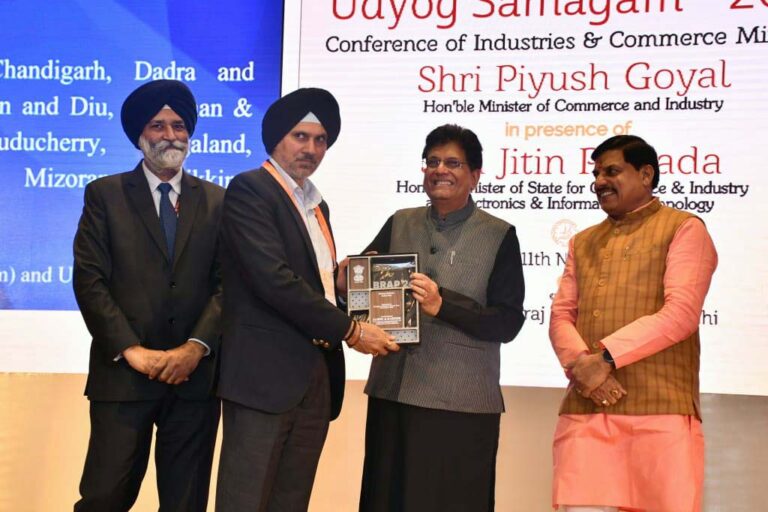
NEW DELHI, NOVEMBER 14: Commissioner Secretary, Industries & Commerce Department, Jammu & Kashmir, Vikramjit Singh today received an award on behalf of J&K Government for emerging as one of the top achievers under Ease of Doing Business (EoDB) and Business Reforms Action Plan (BRAP) 2024 at Udyog Samagam 2025, New Delhi.

The award was presented by Union Minister of Commerce and Industry, Piyush Goyal,.

The Union Government, through Business Reforms Action Plan (BRAP) 2024, assessed States and Union Territories across 25 reform areas driving ease of doing business. The BRAP 2024 assessment, covering 434 reform points, was supported by one of the largest national feedback exercises, involving over 5.8 lakh businesses and more than 1.3 lakh detailed interviews.

Jammu and Kashmir ranked as a Top Achiever with 5th rank amongst all States and UTs with top score in 4/5 critical reform areas. This accolade reflects Jammu & Kashmir Government’s commitment in creating a robust and enabling business ecosystem that accelerates industrial growth, facilitates investments, and ensures regulatory transparency and efficiency.

The recognition at Udyog Samagam 2025 reinforces J&K’s position as a preferred destination for investors and industry stakeholders. Udyog Samagam 2025 brought together industry leaders, policymakers, and state officials to celebrate the spirit of cooperative federalism and collective progress in India’s industrial landscape.

Categories
BUSINESS

35 Kashmir craftsmen to participate in India Int’l Trade Fair in New Delhi

Direct-to-Consumer Sales Platform for World-Famous Pashmina, Kani Shawls, Silk Carpets & more

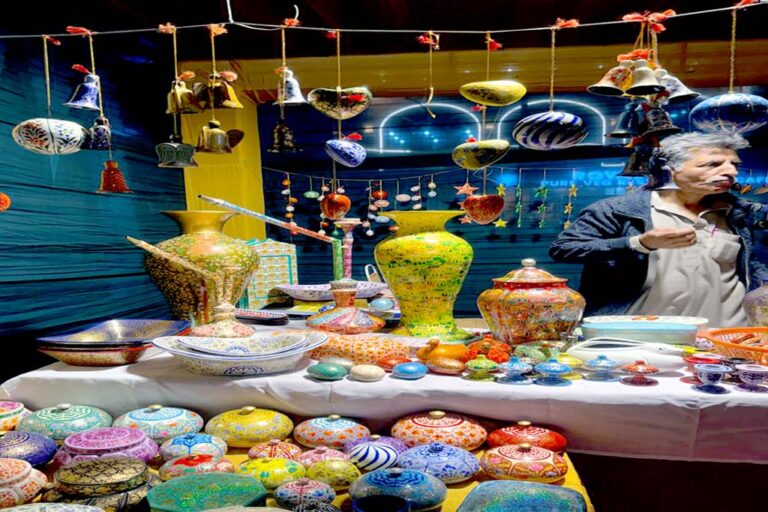
SRINAGAR, NOVEMBER 13: In order to provide direct marketing linkage, as many as 35 artisans and weavers from Kashmir are participating in the 44th edition of the prestigious India International Trade Fair (IITF) 2025, scheduled from November 14 to 27 at Bharat Mandapam, New Delhi.

Organised by the India Trade Promotion Organisation (ITPO), IITF is country’s biggest and most celebrated trade-cum-consumer fair, attracting lakhs of visitors annually.

In a press statement issued here today, a spokesman of the Handicrafts and Handlooms Department, Kashmir, stated that on the requisition of Jammu & Kashmir Trade Promotion Organization, a list of 35 artisans and weavers from Kashmir Division, after draw of lots, was forwarded for participation in the Trade Fair which includes 05 each from Srinagar and Budgam, 03 each from Baramulla, Ganderbal, Anantnag & Bandipora, 02 each from Kupwara, Shopian, Pulwama & Kulgam, and 05 from within the registered Cooperative Societies.

The spokesman further stated that IITF at New Delhi will provide globally-acclaimed Kashmir artisans a direct marketing opportunity for displaying and selling their wide range of exquisite handmade products to domestic and international buyers which include Pashmina and Kani Shawls, Sozni & Crewel embroidery, Hand-knotted Silk Carpets, Walnut Wood Carving and Papier Mache items.

“This is a golden opportunity for our artisans to connect directly with the buyers. IITF 2025 will not only elevate Kashmir’s GI-tagged handicrafts on a global platform but also empower our craftsmen economically by ensuring they retain the full value of their labour,” the spokesman added.

Categories
BUSINESS

Textiles Ministry sanctions 100 more modern looms for carpet weavers

Looms specially designed, offering back-rest and suitable seating arrangement


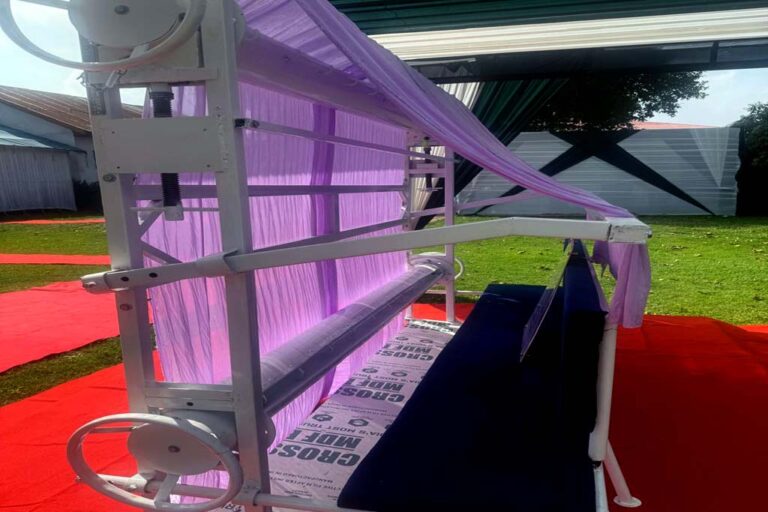
SRINAGAR, NOVEMBER 06: Close on the heels of distribution of 100 Modified Modern Steel Looms amongst the carpet weavers, the Union Ministry of Textiles has sanctioned ₹51.00 lakh for procurement and distribution of 100 more looms under the ‘Wool Processing Scheme’ of the Central Wool Development Board.

Each loom costing ₹51,000 has been specially designed by the Indian Institute of Carpet Technology (IICT), Srinagar, which provides a suitable back-rest and comfort seating arrangement for the weavers.

Sharing details in a press statement issued here today, Director IICT, Srinagar, Zubair Ahmad, thanked the Ministry of Textiles for sanctioning additional 100 Modified Modern Steel Carpet Looms amongst the active weavers for the current financial year 2025-26. “These looms are modified, keeping in view the health concerns of the weavers, who sit for long hours for weaving of the world-famous hand-knotted Kashmir carpets,” he stated.

Director IICT further stated that the Ministry of Textiles has already released the first tranche of ₹30.60 lakh for procurement of the looms. “Once the UC for first instalment is issued, the remaining two instalments shall also be released for procurement and distribution of looms amongst the intended beneficiaries,” he added.

The Department of Handicrafts and Handloom, Kashmir, has advised the interested carpet weavers to approach the offices of Assistant Director Handicrafts/ Handloom, in Kashmir Division for the completion of the requisite formalities.

Categories
BUSINESS

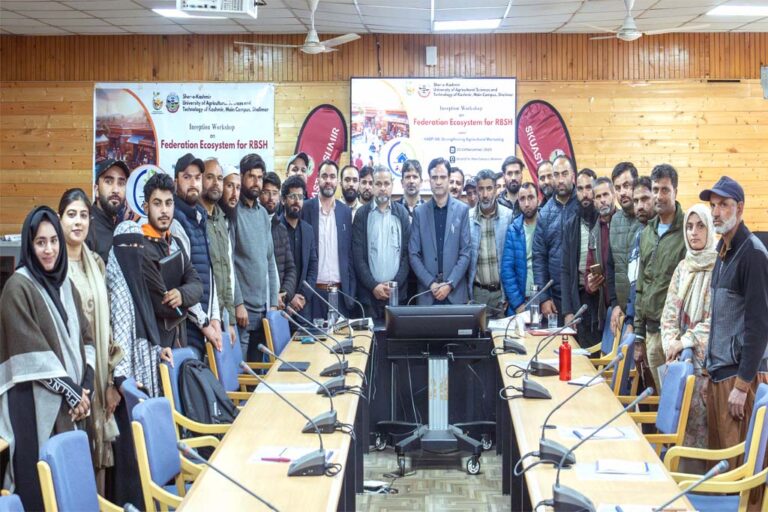
SKUAST-K Charts New Path for Rural Transformation through Federation of RBSHs under HADP-04

Srinagar, November 3: Institute of Business and Policy Research (IBPR), Sher-e-Kashmir University of Agricultural Sciences and Technology of Kashmir (SKUAST-K), kick started a two-day inception workshop on “Federation Ecosystem for Rural Business and Service Hubs (RBSHs)” under the Holistic Agriculture Development Programme (HADP-04) from November 3-4, 2025 at the University’s Shalimar Campus.

The workshop was inaugurated by Ghulam Jeelani Zargar, Director, Horticulture Planning and Marketing, Government of Jammu and Kashmir, who graced the occasion as the Chief Guest. Prof Shabir A Wani, former Director, Planning and Monitoring, SKUAST-K, was the Guest of Honour. The event brought together a diverse group of experts, academicians, field officers, and representatives from emerging RBSHs across Kashmir to deliberate on building a robust, federated ecosystem to accelerate rural enterprise development and agri-business transformation.

In his address, Prof Farhat Ahmad Shaheen, Head, IBPR, and Principal Investigator, HADP# 04, emphasized that the Federation of RBSHs will act as a backbone for decentralized rural development, bridging primary producers with markets, services, and value networks. Presenting the Federation Framework Model, Prof. Shaheen outlined a hub-and-spoke approach to connect individual RBSHs with sectoral experts, agri-input manufacturing firms, digital service providers, and academic institutions to enhance efficiency and market outreach. He highlighted the importance of synergizing policy, practice, and grassroots entrepreneurship, stressing that “building dialogue between policymakers, practitioners, and rural entrepreneurs is crucial for transforming agricultural trade and service ecosystems.” He urged all stakeholders to focus on scalable, innovation-driven business models that empower youth, enhance livelihoods, and strengthen local economies through collaboration and enterprise.

Prof. Shabir A. Wani, in his remarks, lauded IBPR’s vision and leadership in conceptualizing the Federation Model as a scalable and replicable pathway for sustainable rural growth. He emphasized the need for evidence-based planning, integrated development strategies, and long-term sustainability models to empower RBSHs as self-sustaining, dynamic rural enterprises.

Addressing the participants, Shri Ghulam Jeelani Zargar underscored the transformative potential of RBSHs in reshaping the rural economy by enabling last-mile delivery of agricultural services, technology, and business solutions. He reaffirmed the Government’s commitment under HADP to foster entrepreneurial networks and promote institutional convergence among public agencies, private stakeholders, and rural communities.

Dr. Abid Sultan, Scientist, IBPR, and Workshop Coordinator, presented the detailed structure of the workshop, highlighting the thematic sessions on Federation Governance, Business Mapping, Knowledge Integration, and Capacity Building Strategies, and delivered the formal vote of thanks. Ms. Aiman Fayaz, Young Professional, HADP-04, coordinated the workshop proceedings.

The workshop reflected IBPR SKUAST-K’s strong commitment to transforming the agricultural marketing ecosystem by fostering innovation, integration, and rural enterprise development. It reaffirmed the institute’s vision of building a federated, market-led, and technology-driven rural economy under the HADP framework.

Categories
BUSINESS

Fisheries Department Kupwara Stocks Brown Trout Fingerlings in Designated Trout Streams

KUPWARA, NOVEMBER 03: The Department of Fisheries Kupwara has undertaken a significant initiative by stocking Brown Trout fingerlings in the upper reaches of Mawar, Dringyari, and Kalaroose streams, which have been officially declared as trout streams under the J&K Fisheries (Amendment) Act, 2018.
The genetically improved eyed ova of Brown Trout were imported from Denmark under the Pradhan Mantri Matsya Sampadha Yojana (PMMSY) 2024–25 and were reared to fingerling size at the departmental hatchery in Kulgam before being released into the natural streams.
This milestone initiative aims to replenish and enrich natural trout habitats, ensuring the sustenance of fish biodiversity and promoting sport fishing in the region.
Pertinently, Brown Trout, a globally renowned sport fish, attracts anglers from across the world. Kashmir, known as the “Angler’s Paradise,” continues to host thousands of fishing enthusiasts every year.
In Kupwara, several anglers have already started visiting these streams to enjoy trout fishing in the pristine waters. Apart from recreation, trout angling contributes significantly to eco-tourism promotion and environmental conservation, while also encouraging responsible interaction with nature.
The Department of Fisheries has reiterated its commitment to strengthen sustainable fisheries management and promote angling-based tourism in the district.

Categories
BUSINESS

Islamia College organizes seminar on “Handicrafts in Shaher-e-Khaas: Challenges and Opportunities”

SRINAGAR, AUGUST 6: Islamia College of Science and Commerce, Srinagar organized daylong seminar on “Handicrafts in Shahr-e-Khas: Challenges and Opportunities” today on 06th August 2025.

The event brought together a confluence of renowned artisans, academicians, industrialists, researchers, students, and officials from the Government of the Union Territory of Jammu and Kashmir, all committed to rejuvenating the traditional handicrafts sector rooted in the historic downtown Srinagar popularly known as Shahr-e-Khas.

The seminar was formally inaugurated by the Principal of the College, Professor (Dr.) Tehmina Yousuf, who in her presidential address, emphasized the critical need to preserve and revitalize Kashmir’s rich artistic legacy. She underscored the importance of bridging the traditional knowledge systems of artisans with modern market mechanism through academia-industry linkages and innovation. Prof. Tehmina stated that such platforms are vital in creating sustainable, entrepreneurial, and economically viable ecosystems for the region’s heritage crafts.

Dr. Zahoor Ahmad Jhat, Convenor, Innovation & Incubation Centre welcomed the distinguished dignitaries, experts and participants. He elaborated on the College’s vision of fostering innovation and entrepreneurship especially among the youth in the realm of traditional crafts.

The seminar witnessed insightful deliberations by eminent speakers including, Prof. Arshad Suleh, Head, Department of Art, College of Education, who deliberated on the existential challenges threatening this traditional sector such as limited global exposure, dwindling artisan engagement, and market competition from machine-made replicas.

Dr. Syed Iliyas Rizvi, Founder, Education Revival Through Art & Aesthetics in Kashmir, provided a vivid historical overview of Kashmir’s artisanal legacy. He passionately advocated for youth engagement, institutional support, and policy backing to revive the handicraft sector. gave crystal clear picture of the Art and artesian of the Kashmir in general and Shaher-e-Khaas in particular.

Dr. Syed Iliyas Rizvi, took the audiences back into the days of history when this art was the backbone of Kashmir. Dr. Syed Iliyas Rizvi, stressed the importance of institutional support and youth participation to rejuvenate the handicraft ecosystem. He gave insights picture on heritage conservation, export challenges, design innovation, digital marketing, to policy interventions and incubation opportunities.

Prof. Fayaz A. Nika, Director, DIC Dean, School of Management Studies, Central University of Kashmir, highlighted the role of higher education institutions and scientific innovation in revitalizing the crafts industry and addressing bottlenecks.

Ms. Aamina Asad, Chief Designer, Department of Handicrafts & Handlooms, J&K, and Dr. Yasir A. Mir, Assistant Professor, NIFT Srinagar, who both contributed with key insights on design innovation, modern branding strategies, and digital outreach.

The seminar featured panel discussions and interactive sessions, enabling students, young researchers, and budding entrepreneurs to explore innovative start-up models and business frameworks centered around traditional crafts. Participants deliberated on themes such as heritage conservation, design development, export potential, digitization, marketing, and incubation opportunities.

Several artisans from the downtown areas of Srinagar enriched the event with their lived experiences, highlighting on-ground realities and the resilience of the craft sector. The event also attracted research scholars and experts from reputed institutions and central universities.

Principal Professor Tehmina Yousuf, in her concluding remarks, lauded the Innovation & Incubation Centre for conceptualizing and executing a seminar of contemporary relevance in the campus. She reiterated the College’s commitment towards supporting indigenous craft practices, artisan welfare, and community-based entrepreneurship through sustained academic and institutional engagement.

The event concluded with a formal vote of thanks delivered by Dr. Zahoor A. Jhat, who expressed sincere gratitude to all speakers, participants, guests, media representatives, and college administration for their support in making the seminar a resounding success. The proceedings of the seminar were eloquently anchored by Miss Tanzella, a 5th Semester student of the College.

Categories
BUSINESS

Govt releases ₹33.34 lakh for Karkhandar Scheme in Kashmir Div

SRINAGAR, AUGUST 4 – Handicrafts and Handloom Department, Kashmir, today announced release of ₹33.34 lakh for the implementation of its Karkhandar Scheme across the Kashmir Division.
This significant financial allocation, disbursed to the respective Assistant Directors of Handicrafts and Handloom, underscores the Government’s commitment to preserving and promoting the rich artisanal heritage of the region while ensuring the welfare and economic upliftment of craftsmen.
The Karkhandar Scheme, notified in 2021, is a landmark initiative designed to revive languishing crafts like pottery and foster sustainable development of the craft sector in UT of J&K. Implemented by the Directorate of Handicrafts and Handloom, the scheme aims to empower artisans, enhance skill development, and boost the livelihoods of craftsmen through structured interventions.
Highlighting its role in revival of languishing crafts, a spokesman of the Handicrafts and Handloom Department, Kashmir, stated that the Karkhandar Scheme focuses on preserving traditional crafts such as walnut wood carving, silver filigree, carpet weaving, Kani shawl weaving, Khatamband, papier-mâché, and others like Sozni, tapestry, and engraved copperware, which face a shortage of skilled artisans. “It prioritizes crafts at risk of extinction, ensuring their legacy endures. It also facilitates skill transfer from master craftsmen, including National/State/Shilp Guru awardees, to the younger generation,” he said, adding meritorious trainees from departmental training centres receive advanced training in nearby Karkhanas to enhance their expertise and productivity.
Trainees receive a monthly stipend of ₹2,000 during the six-month training period, disbursed via direct bank transfer. “Karkhandars are provided ₹25,000 in two equal installments to cover logistics, tools, equipment, and raw materials, along with ₹2,000 per trainee per month to support their efforts.
This financial release of Rs. 33.34 lakh will empower Assistant Directors, in first phase, of Anantnag, Budgam, Baramulla, Kulgam, and Srinagar districts to accelerate the scheme’s implementation, ensuring artisans receive the necessary resources, training, and support to thrive.

Categories
BUSINESS

₹1.07 Cr revenue generated, deposited in Govt Treasuries from sale of trainee products by Handicrafts & Handloom Dept

SRINAGAR, JULY 17: Demonstrating its sustained efforts in skill development and artisan empowerment, Department of Handicrafts and Handloom, Kashmir, has recorded a cumulative revenue generation of more than ₹1.07 crore over the last three financial years through sale of products crafted by trainees at departmental training centres across the valley.

In a press statement issued here today, spokesman from the Handicrafts and Handloom Department, stated that this revenue, fully deposited in the Government Treasuries, has been realized from the sale of a wide range of handicraft and handloom products produced by trainees enrolled in over 400 departmental training centres which include Pashmina products, Sozni, Crewel, Chain Stitch, Kani Shawl, carpets and a variety of handloom fabrics, reflecting the region’s rich craft heritage. “This also reflects a perfect example of how funds released by the Government are recycled back into the system and utilized for development activities related to promotion of craft sector,” he added.

Department views this achievement as a testament to its ongoing efforts in nurturing traditional skills and enhancing the earning potential of local artisans. By integrating practical, market-oriented production into training modules, Department ensures that trainees gain not just technical proficiency but also a real-time understanding of commercial aspects of the craft sector.

Efforts are underway to further modernize training infrastructure, introduce contemporary design elements and forge stronger market linkages through departmental sale outlets and participation in national-level exhibitions. These steps aim to ensure that products crafted by trainees find broader markets while helping preserve the unique handicraft and handloom traditions of Kashmir.
The Department remains committed to expanding these initiatives, thereby creating sustainable livelihood opportunities for the youth and artisan community of the Union Territory.

Categories
BUSINESS

IICT upgrades skill of 11,000 carpet weavers under various flagship schemes

Also provides monthly stipend ranging from ₹1000 to ₹3750; ₹7500 under Guru-Shishya Scheme

SRINAGAR, JULY 11: In a major boost to expand the pool of trained human resource, Indian Institute of Carpet Technology (IICT), Srinagar, under the aegis of Handicrafts and Handloom Department, Kashmir, has master trained around 11,000 carpet weavers from different districts, under various skill development programmes.

The weavers have been trained on modified carpet looms which shall go a long way in penetrating niche markets for the famed hand-knotted carpets, which is the second most exported handmade product from Kashmir.

In a press statement released here today, Director IICT, Zubair Ahmad said that the services of master trainers who have distinguished themselves in the field of carpet weaving are availed to train skilled and semi-skilled carpet weavers in different batches, both in IICT premises at Bagh-e-Ali Mardan Khan and carpet clusters of different districts. “This face-to-face interaction and training shall go a long way in safeguarding the rare skill of weaving intricate hand-knotted carpets, which have a huge export market, both within and outside the country,” he stated.

The exports of hand-knotted carpets from Kashmir have touched ₹838.70 crore in the last three financial years, despite challenges due to global conflicts which have affected markets in Middle East and other destinations.

In order to make the training programmes more attractive for trainees, IICT also provides monthly stipend as per Scheme Guidelines. “The stipend for these short-term training programmes of 4-6 months’ duration with intake capacity of 20, ranges from ₹1000 to ₹3750 per month under various skill-based schemes of Ministry of Textiles,” he added.

The training programmes include Skill Upgradation and Capacity Building Training & Short-Term Training Programmes of the Ministry of Textiles and Skill Development Training Programme of Ministry of Social Justice and Empowerment.

The Director also stated that under the Guru-Shishya Hastshilp Programme, the services of National Awardees shall be availed to provide skill upgradation training to registered carpet weavers. “Under this 2-month training programme, each trainee shall be provided a stipend of ₹7500 per month,” he stated.

Categories
BUSINESS

Kashmir artisan wins 1st Prize in Iranian Craft Festival

Mir Arshad’s papier mache wall plate wins both heart and art

SRINAGAR, FEBRUARY 25: In yet another recognition at prestigious global event, Mir Arshad Hussain, a noted papier mache craftsman from Bota Kadal, Lal Bazar, has been conferred with the first prize and Diploma of Honor at the 9th International Fajr Festival of Handicrafts, Sarv-e-Simin, at Tehran, by the Iranian Minister for Cultural Heritage, Tourism and Handicrafts, Seyed Reza Salehi Amiri.
Mir Arshad’s entry of papier mache wall plate, which presented a exemplary fusion of traditional and contemporary motifs of Kashmir, scored over 7000 other global entries to receive the first prize in the said festival, along with cash award of ₹65,000.
The festival showcased outstanding and valuable works crafted by master artisans and renowned designers from all over the world, which set highest standards of excellence and originality.
One of the highlights of the award remains the Honorable Mention by the Iranian Culture Minister addressed to Mir Arshad in which he attributed the award to his invaluable efforts and innovative approach in elevating handicrafts. ‘Your creations through your masterful hands stand as a testament to skill, passion and dedication to the cultural and artistic legacy of the world,” it read.
Director, Handicrafts and Handloom, Kashmir, Mussarat Islam met and congratulated Mir Arshad for this rare honour and hoped this international recognition will inspire many others to take famed Kashmir handicrafts on the next pedestal.
An IT engineer by qualification and master craftsman by choice, Mir Arshad extended full support to the Handicrafts and Handloom Department Kashmir, in its endeavour to promote unique crafts like papier mache, which have huge potential in the overseas markets.

Exit mobile version