Categories
BUSINESS

Saffron bloom in Pampore fields

NASIR YOUSIFI

SRINAGAR: Leave the dip in day and night temperatures aside, autumn has turned on a spell in this Himalayan region. While the crimson Chinar leaf falling in the backdrop of red sun during evening hours give a specter, the violet petals of the saffron painting the Karewas of Pampore with colour and fragrance adds to the watchers-treat.

Amidst thousands of herbal bulbs dotting the Karewas sprout the saffron magic, the famed Saffron fields of Pampore in South Kashmir have thrown the valley into poetic gaiety.

By mid-November, it is a festivity around. During this period, Saffron harvest is at its peak in the valley. After a yearlong wait and hard work, it is time to reap the merry-crop.

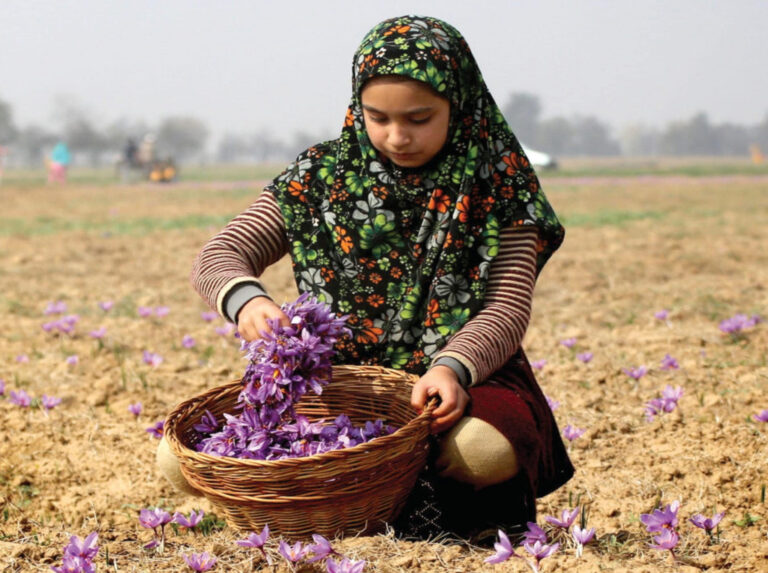
Picking saffron flowers carefully from the vast stretch of fields outside Balhama stretch, middle-aged Fatima Bano along with her 12-year-old school going daughter Zainab is busy collecting the prized spice in her wicker bas-ket.

Not only elders, young and children too are at the forefront to celebrate the festivity of prized harvest.

“It is just like Eid here. Everywhere the people are busy plucking the posh, flower,” says Basit while helping the family to harvest the stock.

It is not only about harvest, along with the colours and aroma, people enjoy the local foods too during the harvest time. “I enjoy the morning Nun Chai and Makai tchout or corn bread, and satu or baked flour in the fields,” a jolly Zainab says, while holding the basketful of world famous saffron flowers.

As the festivity is in the air, how could be the people related with tourism stay immune to the saffron fever. In the first week of November, Jammu and Kashmir Tourism Department organized a mega festival in the Saffron fields of Pampore. Portraying culture, ethics and heritage, Directorate of Tourism Kashmir organized a daylong festival. The festival was attended by many dignitaries from Department of Agriculture, SKUAST, Cooperative societies and hundreds of saffron growers from the area.

Speaking on the occasion, Divisional Commissioner Kashmir, PK Pole who was a chief guest highlighted the im-portance of world acknowledged spice from Kashmir. He said that it is collective responsibility of all the stake hold-ers to preserve and safeguard the reputation of internationally famed Kashmiri Saffron.

The saffron festival was attended by hundreds of people in the karewas of Pampore. Believed to have been intro-duced to Kashmir around first century BC from central Asia, Kashmiri saffron is the sweetest, most precious spice in the world.

Its strands are thicker and more fragrant than its counterpart from Iran, which accounts for more than 90 percent of the world’s saffron production. For Kashmiri farmers, crop sells for as much as Rs 250,000 to 30,000 a Kg. Most of Kashmir’s saffron is grown in Pampore, south of the state’s summer capital, Srinagar.

Kashmir saffron is known to rejuvenate health and is used in cosmetics, medicinal and beverage purposes. It has been associated with traditional Kashmiri cuisine and represents the rich cultural heritage of the region.

Most of the saffron produced in the valley is exported to overseas markets adding hundreds of crores to national economy.

There is good news year for saffron producers in Kashmir. The annual production calculated at the end of 2020 for this costliest spice has been 13.2 metric tons. This is the highest yield in a decade for this sector in the Valley. From the low yield of 1.5 Mts in 2011-12 to 13.2 Mts, this journey has been a mark of revival of saffron economy in Kash-mir.

Saffron, despite its price, is in high demand for its antioxidant properties. It carries a hefty price tag also because the process of converting crocus flowers into the thread-like spice is painstaking and labour-intensive: It takes around 160,000 flowers to yield a kilogram of saffron.

Each year, Kashmir produces 17 metric tonnes of saffron, on average, as per the agriculture department. Saffron is cultivated in three districts: Pulwama, Srinagar and Budgam in Kashmir and Kishtwar in Jammu province.

Last year Kashmiri saffron was granted a GI tag, a feat, experts believe would prove beneficial to the growers in the region.

Geographical Indication is a name or sign given to certain products that relates or belongs to a specific geograph-ical location or origins like a region, town or country. GI helps the genuine producers to earn profit in the competi-tive market and enables the customers to buy products having superior quality.

It is expected that this GI certification will help farmers in getting the best remunerative price and also help in preventing the prevalent practice of adulteration of Saffron, Kashmir’s globally-acclaimed crown of spices that equally adds beauty to picturesque autumn as winter approaches fast!

Categories
BUSINESS

Kashmir carpets to grace Parliament House, boost handicrafts

NASIR YOUSUFI

BUDGAM: On a cloudy evening, Abdul Rahim Khan , a 33-year-old craftsman from Shunglipora village in central Kashmir’s Budgam was busy in helping his wife to milk the cow, when he received a carpet dealers call from nearby village asking for an immediate meet. Sensing urgency, Khan walked down two kilometers from his house to dealer’s home. On reaching the destination, his joy knew no bounds.

Khan is one among a few craftsmen, selected for making a handmade carpet for the highest institution of democracy in the world, the Parliament House of Sansad Bhawan in the national capital, New Delhi.

For a moment, the talented craftsman from a remote area in upper reaches of the valley could not believe the news. Though a school dropout, he knows the importance of the Sansad.

“I have woven more than hundred carpets during my 20 years career as carpet weaver. Where those have been used, God knows better. But this time, I feel really excited that my art will get showcased at such an important place,” exclaims Khan, who is into carpet making since his childhood.

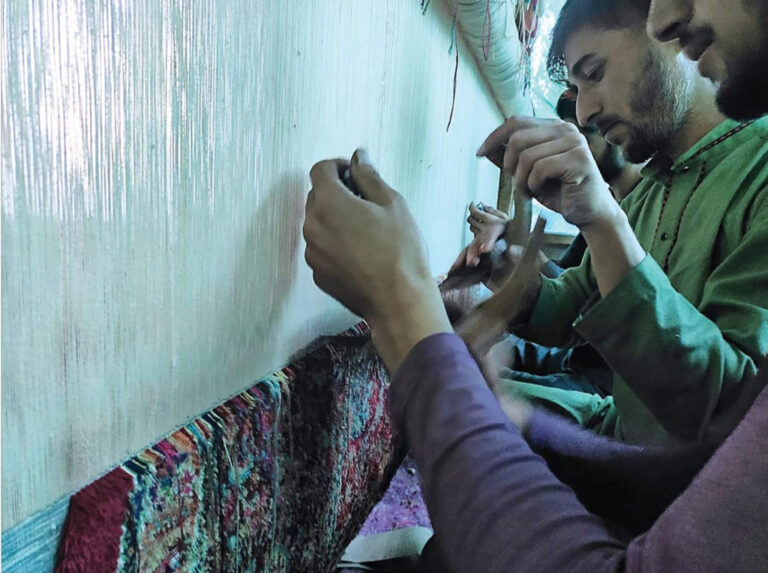
Abdul Rahim Khan is not doing it alone. He is equally assisted by two more siblings, 27-year-old Tariq Ahmad Khan and 29-year-old Reyaz Ahmad Khan in running the loom. The trio is about to complete the prized carpet. “When any of the male members is off the work, a female member from the household works for that time,” Khan adds.

It is not only the Khan family from Shunglipora, there are few more groups of artisans from other villages near lush green Tosamaidan meadows who have almost completed the weaving of carpets for the Parliament House.

How it happened:
It all started in October of 2021, when a 62-year-old local carpet dealer, Ghulam Mohammad Khan Tahiri, the owner of Tahiri Carpets sealed a contract with a Delhi based firm for weaving the carpets. “They only provided us the di-mensions and shape of the carpet, rest has been left for us to decide the design and stuff of carpets,” says Tahiri.

A veteran carpet dealer with an experience of over 35 years in carpet industry, Tahiri immediately sensed the im-portance of the rug for the Parliament. He says, his carpet making company has mainly focused upon the design, stuff and the art used in these carpets.

As the work on these prized handmade carpets for country’s Parliament has been mostly done, the joy has come after a days of intense hard work.

“We have already made carpets for Raddison Group of Hotels and some other big corporate houses. But as soon as I learnt about this prestigious order, I sat down with my father, discussed all the peculiarities about the consignment. We decided to use a quality stuff and master craftsmen for the esteemed project. “After arranging super quality silk from Delhi , the second tough thing was a selection of 12 master craftsmen out of about 120 craftsmen working with us, for this important consignment,” says Qamar Ali Tahiri, Chief Executive Officer of Tahiri Carpets and son of veteran Tahiri.

The timeline for the completion of this project was also a concern. Usually, during summers, many craftsmen take to farming or other labour work in this area, while most of the craft work is carried out in winters. “So we had to moti-vate the craftsmen to work during summers too, for timely completion of work,” Tahiri adds.

Design and Make
With 11 feet in length and 8 feet in breadth, covering an area of 90 sq feet approximately, a trapezium shaped carpet is made from silk on silk, an arrangement when both threads and knots are made from silk. As per Tahiri, there are 288 X 288 knots in one foot length of the carpet.

The prized rugs have been woven in a famed Kashmiri design ‘Shikaar’. Known as the traditional design in local carpet industry, Shikaar is a depiction of jungle life. The images of Lion, Leopard, Deer, Elephant, Peacock or birds are perfectly portrayed on the frame.

“They wanted to craft these masterpieces in a traditional art. So we have chosen this old art for these carpets,” says Qamar while referring to one of the finished carpets, portraying a leopard roaming in a jungle.

The color combination of the prized rugs has been also taken care of. Qamar says, that they have used a combination of 12 colors. “Ranging from Red, Orange, Blue, Green to others, the colors have been used as per the scenery and animal portrayed on the carpet. I still remember, how we had dyed the thread dark red to portray the blood around deer for a scene portrayed on one of the carpets.”

Proud Moments
As the carpets from Kashmir made in traditional art are about to décorate the building that houses the highest law-making institution in India, the local artisans are upbeat with a news. Many artisans are hopeful that the develop-ment may augur well for Kashmiri handicrafts in particular the carpet industry.

According to Dr Shaheena Akhter, a lecturer in Business Studies, the projects like these have a potential to promote local handicrafts, “as they serve as a sort of encouragement for the artisans and opening of more marketing avenues for local craft.”

While the handicrafts from the valley struggle to bounce back to lime light, the likes of carpet-weavers -Abdul Rahim, Tariq and Reyaz they are hopeful of more work.
Says Reyaz: “For me more work means a sustainable livelihood and that is what we people crave for.”

Categories
BUSINESS

Multitalented artist!

NASIR YOUSIFI

SRINAGAR: Shaded in crimson and yellow, as the water colors bring life to the painting hanging bright on canvas, a young artist dips his brush in silver color to give a final shape to his imagination. As soon as the artist sets to relax after hours of toil with his brushes and colors, a triumphant smile over the accomplishment of painting abruptly gives way to another thought process, as he gets a call from local producer asking him to record a shot for his role in a Kashmiri play.

Basharat Hussain, a 40-year-old artist is a prolific artist doing wonders in various field of art. Hailing from Ala-mgari Bazar area from Srinagar’s Shaher-e-Khaas or the Old City, Basharat is a miniature painter, papier-mâché artist, wall art expert, TV actor, theatre artist, a set designer and a renowned art teacher.

Starting his career as a papier-mâché artist, the Srinagar man has come a long way to emerge as a multifaceted personality in the world of acting and theatre as well. Basharat has recently won best director, actor and set designer award for his debut Kashmiri play ‘Archakaal’.

“I started my journey into this world right from my childhood. Since my father was a papier-mâché artist, the colors and brushes all around in my home and neighbourhood used to tempt me towards the art,” says Basharat as he refers to the specialized art in his birth place Zadibal, the area known as the hub of papier-mâché work.

Known as one of the finest artist in papier-mâché, the young artist has so far designed scores of new designs with traditional tinge.

After studying science upto class 12th, Basharat did his bachelor’s degree in Fine Arts from the University of Kashmir here.

Basharat says it was during the college years when the multifaceted artist in him groomed. “After doing some roles in college plays, I soon realized my acting potential. Once as a part of annual day celebrations in the college, I got a chance to perform in a skit. It was when I discovered my acting skills. A small pat, few words of praise from the teachers and friends were enough to dig out the actor in me,” he says.

An approved artist from Doordarshan Kashmir, Basharat has so far acted in more than 50 plays. For his splendid acting talent, the artist was awarded the best actor title in numerous plays performed at the theatre.

The ambitious actor did not stop here. After getting a fair exposure to the world of acting both in theatre and TV, the enthusiastic artist turned to set designing.

“Incidentally, the first theatre play where I designed the sets was a play in English, the Fading Memoirs. I also acted in that play,” says Basharat.

In 2018, he designed set for a Kashmiri play ‘Aalaw’, a masterpiece that got selected for 8th Theatre Olympics. Basharat says he still remembers the patting he received from M.S Sathyu , a renowned Director and set designer in the country.

Besides working with local theatre, Basharat has designed sets for many Bollywood firms shooting in the Valley.

The young artist has also worked as a director for theatre plays. Last year, as a director, his de-but play ‘Archakaal’ won him the accolades from artistic faculty for the all-round-performance. The play got some seven awards including the best director and set designer awards.

The passion for art has never stopped this young artist from taking on to different roles. Out of his busy schedule, Basharat spares many hours of the day for teaching art and imparting skills to students. Well, for that matter, he is regarded as one of the renowned art teachers in the valley.

“I want to transfer these skills to future generations. Art is a language of peace, coexistence and love. Through art we can make this world a better place to live. It is the means to develop aesthetic sense in the society,” the veteran artist says.

“Be it a painting, wall art, play or the set designing, everything is symbolic in the world of art. And every symbol has a specific message and meaning for the society. Art is a lucid medium to sensitize the common masses about the issues like drug menace, immorality, or other social evils.”

Desirous of reviving the theatre culture in the valley, Basharat aspires to take the culture to valley schools, so that the artistic values among the younger generation are groomed at the grassroots.

“There is a role of every responsible citizen to promote art in the society. The government has a major responsibility. The government should utilize the services of the artists and experts from the field to inculcate the culture of art among the youth especially the student community!”

Categories
BUSINESS

Carving life out of deadwood!

NASIR YOUSUFI

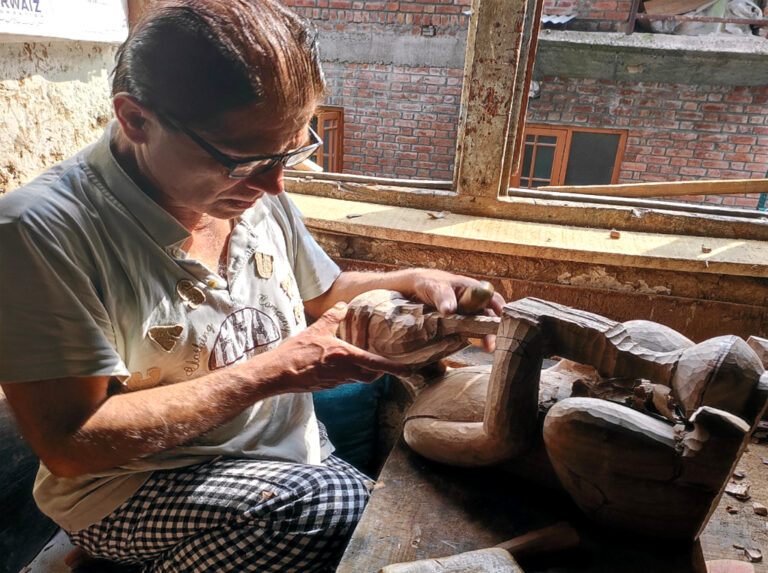
SRINAGAR: With sheer passion and unmatched brilliance, a specially-abled artist, deaf and mute since the birth gives life to wood. He is the man with golden hands – 55-year-old Muhammad Yusuf Muran!

As soon as the clock tickles to 9:00 AM in the morning, sporting a festive smile, he comes downstairs and slips into the backyard of his house. After giving a thorough look, he selects a block of round wood among a number of cut logs, lifts it into his two hands and slips into a small room. Keeping the wooden block on a raised platform in his long but narrow workshop, the man begins to mark it all over with a marker. Hours after the intense chisel and hammer work, a triumphant smile flashes on his face as he is able to see the first outline of imagination.

Hailing from Srinagar’s downtown area or Shaher-e-Khaas, he produces a class of art in the form of artifacts and mementos carved in wood.

Nestled in the lanes and bylanes of the Narwarah area of Srinagar, Muran’s small workshop can send any onlooker into nostalgia. An elderly Kashmiri puffing a traditional Hookah, family enjoying the samovar tea in rural land-scape, a group of elephants strolling in a field, a large sized eagle spreading its wings, Sir George seated on magnifi-cent horse fighting a dragon and the replica of famous Jamia Masjid in Srinagar are among his outstanding artworks showcased at the workshop. Made at this small workspace, these replicas and mementos have won Muran a world-wide recognition and accolades.

“I am a staunch lover of wood carving art. I have seen many masterpieces from various artists, but this man has got a unmatchable class in his work. I have never seen such a perfect art elsewhere in the field,” says Sumaira, inte-rior designer and ardent lover of handmade art from Central Kashmir’s Budgam. This man has simply got golden fingers, she adds.

Defeating his disabilities with a mix of imagination and perfection, the deaf and dumb wood carving artist, has learned the art from his father and elder brother. “He has learned this art since childhood. Initially, he learned it from his father late Ghulam Ahmad Muran and then from his elder brother Abdul Ahad Muran, who passed away few years ago,” says Arsalan Yousuf, younger son of Muhammad Yusuf Muran.

“My father is like any other artist in the field, but one of the reasons behind the popularity of his artwork, I think, is his dedication and hard work. Every day, he works for almost nine hours on wood from 9 am to 6 pm except on Friday. In the first half of the day, he goes to local market for purchasing the raw material and in the other half, he visits different religious places to offer prayers,” says Arsalan.

“Almost a decade ago, our family faced a lot of financial instability. A chunk of a people used to benefit from my father’s hardwork. He was only paid peanuts while the major portion of the profit used to fill the pockets of the mid-dlemen.”

“However, after my cousin brother opened a wood carving store, our family has witnessed a huge change in in-come, as we are able to sell our products to customers directly now,” adds Saqlin, Muran’s other son.

“Presently, I am able to sell the products of my father both offline as well as online. I even receive orders on social media handles too. Our customer base is increasing day by day, as apart from the buyers within the country, many orders come from Arab and European countries. Since my father cannot talk, I am looking at marketing part of my family craft,” says Saqlin.

As the 200 year old family craft is finally paying benefits to Muran family, the business suffers the shortage of quality wood. There is a dearth of superior walnut and deodar in the market, the artisans say. “We have to often pay extra money for getting the quality material and that makes the craft more costly,” Saqlin adds.

Muran, who only uses quality wood of walnut or deodar for his work, takes special care while choosing the mate-rial for his artwork. “I have never seen him using substandard material”, says Saqlin while referring to his father who works in a corner of his workshop, carving a replica of “Old man holding Hookah”.

While Muran is busy in creating scores of masterpieces, annually earning the family a name and fame in the field, unfortunately, there are almost no new takers to learn the art from this brilliant wood carving artist!

Categories
BUSINESS

Women farmers cultivate success stories in Ladakh’s Changthang

NASIR YOUSIFI

CHANGTHANG: The cold desert where climatic conditions otherwise prevent establishment of even small a kitch-en garden, is now a hub of modern agricultural practices. Nyoma, the high altitude village in the Changthang region of Ladakh is now a home to a variety of vegetables and crops.

Changthang is located in the eastern part of Ladakh Union Territory. With altitude ranging between 4000 to 7000 meters above the sea level -the region is one of the highest inhabited in the world.

Lying in the rain shadow of Himlayan ranges, the area experiences cold and long winters and a very less plant production.

Amidst the gusty winds outside, a young woman is busy pruning the soil inside a low lying tunnel made mostly of mud bricks. Her tunnel, located at Nyoma, one of the world’s highest altitude village is one among the scores of tun-nels and green houses growing green vegetables.

Dechan Chogdol, a 35-year-old farmer grows thousands of cucumber in her farm. Interestingly, she also grows a variety of other green vegetables in few more tunnels built on an open patch of her ancestral land.

Nestled amidst the barren mountains, the high altitude Nyoma could only produce few varieties of arid crops like barley or turnip till a few years ago. But thanks to modern agricultural practices, the region witnesses now an agri-cultural prosperity.

“Nothing grows in Changthang, these words said in a high level meeting about the prospect of agriculture in Ladakh’s high altitude region, pinched me a lot,” recalls Dr Jigmet Yangchin, Programme Coordinator and a head of Krishi Vigyan Kendra SKUAST-K, Nyoma.

“As soon as I left the meeting , I along with others devised a plan for mass agricultural reforms in the area. With the support of the department, our unit launched a mass awareness campaign among the farmers about the benefits of agriculture. Since the people in the region are mostly nomads, to motivate them to use new technological inter-ventions was a challenge. But we succeeded in motivating many people including women to take onto modern agri-cultural practices,” Dr Jigmet explains.

Dr Jigmet says that the green house in Changthang looks quite similar to any other green house in plains, but in structure there is a vast variation. “These houses are made from clay bricks which are arranged in two layers. The straw is used to fill in a gap between the two layers of bricks which acts as an insulator. The roof is made from wil-low and popular branches… The green house in the region have south fencing,” the senior scientist says.

“These green houses are low cost structures, since they are made from locally available resources. These struc-tures are designed to trap maximum amount of solar energy.”
Besides green house, the farmers in the high altitude region also use low tunnel and trench techniques to grow vegetables.

In a small low lying tunnel in the same village ,Tsering Angmo, a 55-year- old women farmer spends most part of the day growing mushrooms. “Few years ago, I was only growing barley or occasionally turnip, I used to grow in this patch of land. But thanks to KVK, that now I am able to grow a cash crop,” the progressive farmer says while refer-ring to bags of sprouting mushrooms in a tunnel.

Traditionally the region has been growing barley, a crop that successfully grows in arid conditions. For the want of conducive climatic conditions, the vast patches of land amidst the mountains have remained untouched.

Records available with the Krishi Vigyan Kendra, Nyoma suggest that there are around 500 farmers in the area and about 2200 in the whole Changthang region. Since most of these farmers are nomads producing meat and wool, however, there are many farmers now who are growing green vegetables and other cash crops. A large number of women in the nomadic community are showing a special interest in modern agriculture.

In Muth, a model village which is considered a hub of cucumber cultivation, Sona Chungdol grows a large quantity of cucumbers. “Cucumber is not an only source of income, I grow around six varieties of tomato and one variety of brinjal in these farms,” says Chungdol, while referring to a group of green houses and trenches made on her farm land.

Categories
BUSINESS

Floating village Kachri Mohlla – new attraction in Dal Lake!

Srinagar: Amidst the overwhelming tourist footfall this year, Kashmir tourism has added one more feather in its cap. Kachri Mohalla, a picturesque village in world famous Dal Lake has been developed as the floating village with home stay facilities.

The picturesque habitation nestled amidst the waters of the lake between Zabarwan and Kohimaran hills has made it to world tourism map. Conceived as the model tourist village, Kachri Mohalla a small village is being flagshipped as a tourism destination fully equipped with the state of the art facilities.

The Kachri Mohalla was developed as a Model village comprising home-stay and other facilities by Indian Army with support of some government departments. This would be a revolutionary transition for in influx of tourism towards inlands of Dal Lake. Subsequently government of Jammu and Kashmir would undertake five more hamlets for developing as Model Village.

The location is away from congestion and overcrowding which leads a peaceful, natural, serene homely stay. Experts said this would be major boost to tourism industry, employment generation and upliftment of the society.

According to official of the Indian Army,  who looked after the development of Kachri mohalla into model village, “the Jetty or Ghat has been developed near the destination and the houses of village have been painted to give aesthetic taste to the onlookers.”

“We also undertook the leveling of the ground and plantation drive. The labour involved in face-lifting the neighborhood was all from the locality and that has also helped in providing employment avenues for local population.”

The area has been declared as plastic free. Bestowed with the serene beauty and calm, the destination is projected as one of the better home stay abode in the valley as the place is away from the congestion and crowded commercial places. As the valley has recently seen the full occupancy of accommodation across the major tourist destinations, it is believed that the place is going emerge as a major crowd puller in Dal Lake.

“Conventionally the place has been almost cut off from the city for the lack of proper road connectivity. The development of the area as a model village will definitely help in proper connectivity with city on modern lines “, says Muhammad Afzal Moti, a local resident from Kachri Mohalla.  Moti further says, that the project has given the local population a ray of hope for better life.

Since the place is bestowed with natural landscape, the culture and tradition exhibited in the village provides on hands experience of local and natural lifestyle. Apart from having insiders feel in the village, there are many things tourists can indulge in. Angling, boating and swimming are another activities the people can enjoy from in the village.

As the houses in the locality glow in same colour for their “painted roofs and similar walls”, the beauty of the village serves a treat for the eyes of the visitors, who approach towards the village on water jetty. This is really a new look of the area. It is extraordinarily amazing! I have come here for a photoshoot, says a Majid Ali, a college student from neighboring town Pampore.

While the village is being projected as a major tourist attraction, local inhabitants are optimistic about future of the village. “They will come here, stay, buy consumables, handicrafts and our services. And this will surely help in generation of the employment in the area,” hopes Tasaduq, a young local.

Experts believe that the village with humble economic and educational parameters would see the boost in socio-economic indicators with robust tourism activity.

As the jetties with tourists move across lake from Boulevard to Kachri mohalla, the development of the floating village inside Dal lake is seen as an act of empowerment in the area. As the tourism activities picks up, the area will see more happiness and prosperity, believe the experts.

As Kachri mohlla emerges as the first model tourist village in  Dal, Tourism department along with other government agencies are mulling to develop four more such villages around the water body to increase the tourism avenues in the valley.

Srinagar Municipality Corporation has recently announced the development of cycle tracks in the area. According to an official from the corporation, the cycle track will come up under the smart city programme in the area and would cater to long pending demand of adventurists and cyclists from the city. The paddling activity in the area will add to the projected hustle and bustle around the lake.

Tourism community too is feeling buoyed by the tourism related developments in the area. People from the trade believe that it would provide more options of accommodation and sightseeing for tourists. They believe that such projects should be taken in other parts of the valley too.

While the boats and jetties  steer towards the interior neighbourhoods of Dal, tourism activities in Kachri mohalla, the first floating village of the valley are gaining momentum.

Categories
BUSINESS

CHANGING TRENDS: Dairy farmers look beyond milk

NASIR YOUSUFI

SRINAGAR: As the valley witness bumper production of milk over the past years, the dairy farmers have taken to production of nature based home made dairy products. Be it curd, butter, ghee or cheese, the demand for these home preparations trends in urban Kashmir.

Equipped with two large canes, a man juggles door to door early morning in a distant village of South Kashmir. Most of the households scattered over a picturesque hamlet at Ladhu in south Kashmir’s Pulwama produce surplus milk. Ghulam Mohammad Lone , a middle aged milk vendor from adjacent locality regularly collects the surplus yield from the village. Lone does not resell the raw milk but he uses it to make paneer for the market. Lone says, He has found a new line to earn a livelihood.

Lately hundreds of dairy farmers are engaged in the production of homemade dairy products in the valley. Owing to the increased demand coupled with surplus yield, dairy farmers find extra cash in homemade milk products.

While demand for dairy produce across the country is growing, the price of milk and allied products across Jammu and Kashmir is also picking up. Seeing the grass greener, many farmers across the valley have taken to the produc-tion of homemade dairy products to capitalize on the increased demand.

Thirty kilometers away from Lone’s home, 45 year old Abdul Ahad Bhat pushes curd laden bicycle through subur-ban Srinagar. Every day, the old aged Bhat , flaunting a trimmed grey beard paddles twice through the lanes and by lanes in Ishber and Shalimar. While on the evenings, he purchases loads of raw milk from the households, Bhat spends the whole mornings in supplying the ‘Zamdud’ or curd to the market.

My single daughter and an elderly wife spend hours together to process the days collection. After boiling the milk for hours together, they distribute milk among ‘ vaer’ or earthen matka of different sizes and 15 litre buckets. After adding a pinch of ferment, the pots are left overnight to get the curd, says the septuagenarian.

Five year back, I used to sell raw milk in the market. But as the competition increased due to surging production, I switched to curd making. There is a good demand for curd. I sell about 100 units of curd packed pots every day, says Bhat, while delivering the value added milk to roadside eatery adjacent to a famous tourist spot, Mughal garden Shalimar.

The contribution of the dairying sector to the national income is invaluable. This sector helps in increasing the crop production by providing the drag power, organic manure and cash income on a regular basis,” said the experts. Ex-perts also say that it is very easy to produce milk in a green land like Kashmir.

Not too far from Shalimar , Mohmmad Aslam Khatana a middle aged man from Dara village has taken to the pro-duction of Ghee. Located in the foothills of Mahdev mountain peak, the remotest village in the Srinagar has good population of livestock. Area supplies hundreds of liters of milk to urban areas every day. Seeing the surplus sup-ply, like many others, Aslam has taken to the making of Desi ghee.

The increased level of health consciousness gradually creates a demand for the nature based food, the demand for homemade dairy products gets the boost.

A large number of customers prefer the home made dairy products. I usually sell the stock of homemade curd and butter within an hour in the morning. There is a growing demand for these dairy products. People often ask for these products. However, I can cater to few given the limited stock I get from a local dairy farmer. In particular, there is a dearth of desi ghee and butter in the market.

Towards the north, in Odina village of Bandipora, middle aged , Shakeela along with her husband , Mohammad Jaf-far Bhat runs a successful business of Cheese making. Within a few years, the family produces about a 300 kilograms of Cheese every day from hundreds of litres of surplus milk collected from cattle rearing households in the nearby villages. Like Shakeela, there are many dairy farmers who are taking to newer means of value addition to their pro-duce in the market.

“Jammu and Kashmir is producing 70 lakh litres of milk per day, also strengthening the public private partnerships, besides this Kashmir alone is producing 40 lakh litres of milk per day,” says Ms Purnima Mittal, Director Animal Husbandry Department Kashmir.she said Kashmir alone produces 40 lakh while as Jammu produces 30 lakh litres, respectively.

Categories
BUSINESS

Pencil Village The Wood that goes in to the making of Pencils in India is supplied from Kashmir

Surrounded by apple orchards, emanating mouth watering aroma, a habitation in Vakhoo from Kakapora area of Pulwama has come to lime light for good reasons. Catching on the special wood from poplars grown in the wetlands of the district, the village is a hub of manufacturing pencil slates. Supplying 70% of processed wood to the pencil industry in India, Vakhoo has carved a niche in preparing the basic raw material for the writing stuff, earning an epithet ‘Pencil village of India’

 Pencil slate manufacturing units in Vakhoo   from Kakpora Pulwama give any onlooker the feel  of an industrial area. As the village witnesses a great industrial activity for thousands of workers, men and women engage in the processing of Pencil wood from their houses , since most of the units engaged with the trade operate from the local houses.

The process starts with the growing and felling of special poplars  that fetch the basic ingredient ‘wood’ for the slates. Laden with right amount of moisture, that makes it fit for the making of pencil wood,

the kind of a special poplar trees grows in abundance in the wetlands around.  After shearing the trees into cut size logs, the finest of wood is selected to make the Planks. These planks are then trimmed into five millimeter thick slates of standard pencil size.

The process does not stop here. After it has been seasoned into a particular size, the slates undergo a cycle of quality checks, ensuring the removal of knots if any and smoothing of rough edges. It is only after drying these slates stacked in a tall and wider ring patterns, the half processed pencils are ready to be packed. Packed  800 pieces in a bunch, these slates are dispatched in large nylon bags  to the respective destinations outside Kashmir says Mubashir Ahmad, a unit owner from the village, while explaining how these units process the wood for the pencil  industry in India.

Village supplies more than 70% of processed wood to pencil industry in India. Our main buyer is Hindustan pencils , the maker of  Natraj says, Manzoor Ahmad Allaie, pencil slate manufacturer and President of Pencil Manufacturing unit holders union, Kashmir. Off late, we have started to get orders from many Multi National Companies within and outside India, informs an enthusiastic entrepreneur Manzoor.

Apart from adding to the exchequer of Kashmir, the trade is a generous job creator. Large number of workers local as well as non locals, both men and women are employed in these units. Barkat Saw Mills owned by Feroz Ahmad has hundreds of people on its payrolls. “My unit provides job to about 200 people throughout the year”, says another unit holder , Firdous Ahmad. “I am happy that our endeavor is helping educated and unemployed youth to earn a respectable livelihood”,Firdous adds.

Women workers have their due share in the manufacturing activity. Along with the male counterparts,  a sizeable number of educated young girls are dispensing their services stacking, drying , packing the pencil slates. Keeping the records and operating the computers, some girls engage in the official activities in these units. “Despite being a college dropout, I earn a handsome monthly salary ”, says a content Shaheena, employed in one of the pencil slate manufacturing unit in Vakhoo.

Started decades ago, the pencil village in Pulwama can become the economic hub in the valley, provided  proper and sustained attention at administration level is paid to the trade, says Nissar Ahmad Sheikh, Vice President, Federation Chamber of Industries Kashmir. “Twenty four hour electricity supply, provision of Government or personal land to the pencil slate manufacturing unit holders, Hassle free documentation and tax exemption are can be major encouragement to this budding industry”, says Nissar.

“Since this  school allied industry, creates almost five thousand jobs directly and more than ten thousand indirectly, government should actively think to downsize the present  GST from 12% slab to 5% slab applicable to essential goods”, Nissar demands.

According to some entrepreneurs from the village, lack of land to expand the operations is another hiccup in this potential job creating business. “There is large portion of government owned land vacant, adjacent to my unit. If provided on lease or purchase basis, I would have to double the employee size of my unit, since  large number of orders from many MNC’s are pending for the want of expansion of unit operations”, claims Manzoor Allaie.

The recent statement from the top officer of the district  Raghu Ranjan, Deputy Commissioner, Pulwama has encouraged us, says hopeful Manzoor. Deputy Commissioner , while speaking to the media  recently had announced that the village will be soon officially declared as the ‘Pencil village of India’.

Exit mobile version